riwaya.

riwaya.🇲🇦
We use cookies to improve your experience, analyze our traffic, and offer you personalized offers. Learn more in our Privacy Policy.
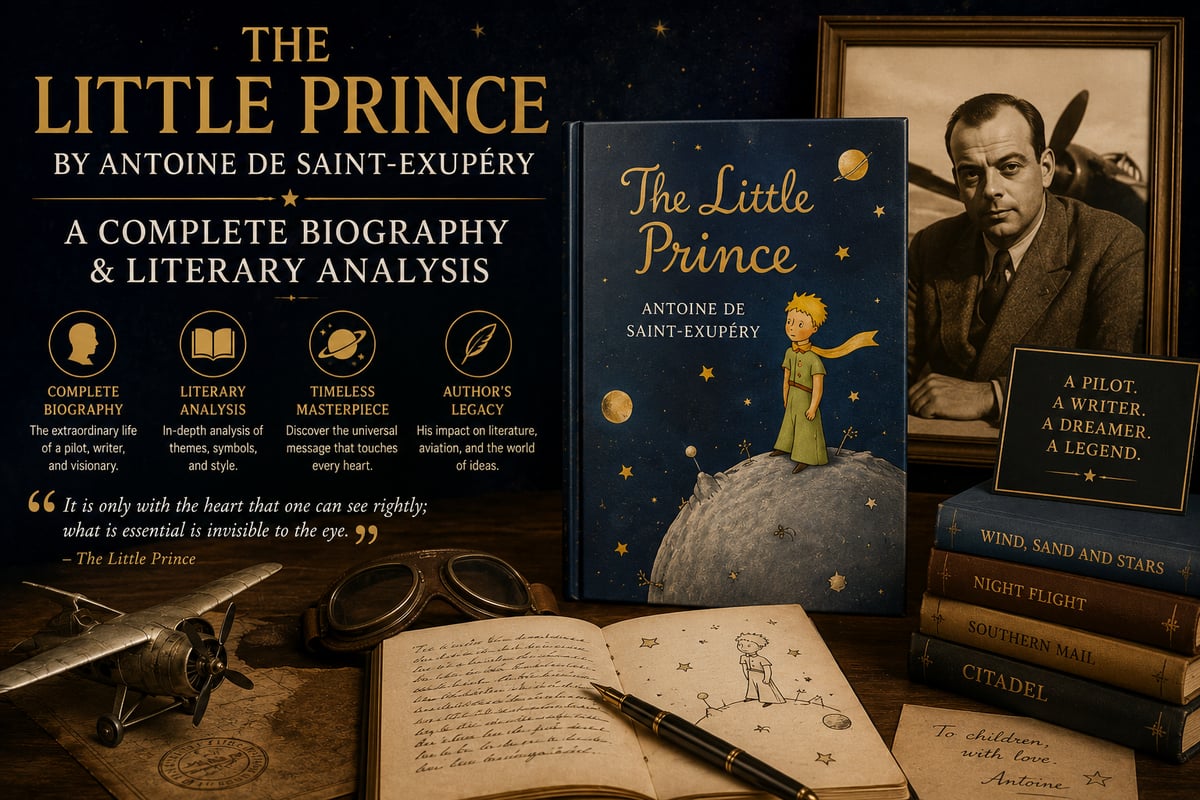
Published in 1943, The Little Prince (Le Petit Prince) by Antoine de Saint-Exupéry is one of the most beloved and widely translated books in history. Part fairy…
Published in 1943, The Little Prince (Le Petit Prince) by Antoine de Saint-Exupéry is one of the most beloved and widely translated books in history. Part fairy…
This article was written by Sarah Jenkins.
Antoine Marie Jean-Baptiste Roger de Saint-Exupéry was born on June 29, 1900, in Lyon, France, into an aristocratic family with deep roots in French nobility. He was the third of five children, and from an early age showed a passionate curiosity for the world around him. His father, Jean de Saint-Exupéry, died of a stroke in 1904, leaving his mother, Marie de Fonscolombe, to raise the children largely on her own. The family moved between family châteaux, and it was during these early years that Antoine developed his love for nature, storytelling, and imagination.
As a young man, Saint-Exupéry struggled academically, failing his entrance exam to the École Navale (French naval academy). His life changed direction decisively in 1921 when he joined the French military aviation service. He learned to fly and immediately fell in love with the sky. This passion for aviation would define both his career and his literary voice for the rest of his life.
After military service, he worked as a commercial pilot for Latroécoere, later called Aeropostale, flying mail routes across the Sahara desert and South America. These dangerous routes — often through storms, mechanical failures, and hostile terrain — gave him the raw material for his early masterpieces: Southern Mail (Courrier Sud, 1929) and Night Flight (Vol de Nuit, 1931), the latter winning the prestigious Prix Fémina and bringing him international fame.
In 1931, he married Consuelo Suncin, a volatile, artistic Salvadoran widow. Their relationship was passionate and stormy, marked by mutual infidelities and long separations due to his flights. Many scholars believe Consuelo inspired the character of the Rose in The Little Prince.
During World War II, after France fell to Germany in 1940, Saint-Exupéry fled to the United States. Living in New York and then on Long Island between 1941 and 1943, he wrote The Little Prince during a deeply melancholic period of exile, homesickness, and despair about the state of the world. The book was published in April 1943, simultaneously in English and French by Reynal & Hitchcock in New York.
Despite being considered too old to fly combat missions, he lobbied relentlessly to return to the French air force. He was permitted to fly reconnaissance missions over southern France. On July 31, 1944, he took off from Corsica on his ninth mission — and never returned. He was 44 years old. His plane was never found until 1998, when fragments were discovered in the Mediterranean Sea off Marseille. In 2004, the wreckage was officially identified. The circumstances of his death remain officially unexplained, though it is widely believed his unarmed aircraft was shot down by a German fighter.
The Little Prince begins with a narrator — an airplane pilot — who crashes in the Sahara Desert and is alone with his broken engine. There, he encounters a small, golden-haired boy who claims to have come from a tiny asteroid called Asteroid B-612. This is the Little Prince.
The Narrator and the Little Prince: The narrator, who as a child drew a picture of a boa constrictor swallowing an elephant that all grown-ups mistook for a hat, immediately recognizes the Little Prince as someone who truly sees and understands. Their unlikely friendship forms the emotional backbone of the book.
The Little Prince's Travels: Before arriving on Earth, the Little Prince had visited six other asteroids, each inhabited by a single, absurd grown-up:
On Earth, the Little Prince arrives in the Sahara and meets a Snake who speaks in riddles and hints at being able to return him home. He then wanders, discovering a garden of thousands of roses, which deeply saddens him because he believed his own rose on his asteroid was unique in the universe.
The Fox: The Fox is perhaps the most important character after the Prince himself. The Fox asks the Prince to tame him — to create a bond between them. Through this relationship, the Prince learns the book's most celebrated lesson: that what makes something precious is the time and love invested in it. The Fox reveals: "It is only with the heart that one can see rightly; what is essential is invisible to the eye."
The Rose: Before leaving his asteroid, the Little Prince had a single rose — beautiful, vain, demanding, and vulnerable. He loved and cared for her, but her dramatic moods and demands eventually drove him away. Throughout his journey, he slowly comes to understand that she was his rose, unique and irreplaceable despite her flaws, and that he was responsible for her.
The Ending: The Prince, longing to return to his rose and his planet, allows the Snake to bite him. His body falls gently to the desert sand. The narrator believes he has returned to his asteroid. The book ends with a haunting illustration of the night sky and a question: if you are ever in the desert and see a laughing child, you will know where he is.
The Little Prince operates on two levels simultaneously: as a charming children's story and as a rich philosophical allegory about the human condition. Its themes are timeless and universal.
The Corruption of Adulthood: One of the central themes is the contrast between the clear-eyed innocence of children and the blinkered, self-absorbed world of adults. Every grown-up the Little Prince encounters on his planetary tour represents a specific human failing: vanity, greed, blind obedience to duty, and obsession with power and ownership. Saint-Exupéry saw modern civilization — with its materialism, bureaucracy, and loveless rationalism — as a catastrophic loss of wonder and meaning.
Love, Responsibility and Attachment: The relationship between the Prince and his Rose is a meditation on the nature of love. The Rose is not perfect; she is vain and manipulative. But the Prince has watered her, sheltered her from the wind, and listened to her complaints. This act of caring creates an irreplaceable bond. Love, the book suggests, is not about finding the perfect being but about the time and devotion you give. The Fox's teaching — that you become responsible forever for what you have tamed — echoes throughout the narrative.
Loneliness and the Search for Connection: Every character in the book is profoundly alone. The narrator is stranded in the desert. The Little Prince wanders the universe. The Fox lives alone in a wheat field. Even the Rose is alone on her asteroid. The entire book can be read as a meditation on human loneliness and the fragile, essential beauty of genuine connection — however brief.
The Invisible and the Essential: The Fox's famous phrase — "what is essential is invisible to the eye" — is the spiritual key of the whole work. Saint-Exupéry argues that modern society has lost touch with the invisible: friendship, love, beauty, meaning. These cannot be counted or owned; they can only be felt. The Businessman who "owns" millions of stars is the perfect counter-image: rich in facts, bankrupt in spirit.
Death, Sacrifice and Return: The ending, in which the Prince allows the Snake to bite him in order to shed his heavy body and return to his asteroid, is one of literature's most poignant treatments of death as transformation rather than ending. Saint-Exupéry, who himself disappeared into the sky, seems to have anticipated his own death in these pages. The Prince does not die — he goes home.
The Baobabs: The baobab trees that threaten to overwhelm the Prince's small planet if not rooted out every day are one of the book's most powerful symbols. They represent the destructive habits, ideologies, and character flaws that, if ignored, can grow to consume a person or a civilization entirely. Saint-Exupéry wrote this as Europe was being consumed by fascism.
Writing and Publication: The Little Prince was written between 1942 and early 1943, during Saint-Exupéry's painful exile in the United States. He worked on it while staying at the Long Island estate of a wealthy friend, Bevin House. He was deeply homesick, estranged from his wife Consuelo, and tormented by France's defeat. The book poured out of him with remarkable speed, accompanied by his own watercolor illustrations.
The book was published on April 6, 1943, simultaneously in English (translated by Katherine Woods) and in French, by the New York publisher Reynal & Hitchcock. It was not published in France until after the Liberation, in 1945, as Saint-Exupéry's work was banned under the Vichy regime due to his association with the Free French forces.
The Illustrations: One of the most distinctive features of The Little Prince is that Saint-Exupéry illustrated it himself with his own watercolor paintings. These gentle, luminous images — the Little Prince standing on his tiny planet, the rose under her glass dome, the Fox in the wheat field, the boa constrictor digesting an elephant — have become among the most recognizable images in world literature. Saint-Exupéry was reportedly so attached to these illustrations that he was deeply unhappy with the quality of the reproduction in the first edition.
International Reception and Legacy: The book became an instant bestseller in the United States. Today, The Little Prince is:
In France, the book holds an almost sacred cultural status. From 1993 to 2002, the image of the Little Prince and his rose appeared on the French 50-franc banknote. The asteroid B-612 features prominently in the story — and fittingly, asteroid 2578 Saint-Exupéry was named after the author by the International Astronomical Union.
Dedicated to Léon Werth: The book famously begins with a dedication to his friend Léon Werth, a Jewish writer stranded in France, with the author's apology for dedicating a children's book to a grown-up, followed by a touching explanation of why Werth, even as an adult, deserves it: because he understands everything, even books for children.
More than 80 years after its publication, The Little Prince continues to be read, loved, debated, and discovered anew by each generation. What accounts for its extraordinary durability?
A Book That Speaks to Everyone: Unlike most books classified as children's literature, The Little Prince explicitly addresses adults as its primary audience — or rather, adults who have not forgotten what it means to be a child. It operates on multiple levels. Young readers enjoy the adventure of a small boy traveling through space. Adults recognize in it a parable of their own lives: the relationships abandoned too hastily, the beauty overlooked in daily routine, the spiritual emptiness behind material success.
The Universal Longing It Captures: At its heart, the book is about the human need for love and the terror of loss. The Little Prince loves his rose despite her flaws. He tames the Fox knowing he must leave him. He chooses to "die" in order to return to what he loves. These are not childish themes — they are the deepest themes of human existence, expressed with the simplicity and clarity that only a master writer can achieve.
Its Relevance Today: In an age of social media, algorithmic distraction, and the commodification of everything, The Little Prince's warning against the grown-up world feels more urgent than ever. The Businessman counting his stars is the perfectly drawn caricature of a world that measures worth in numbers and profit. The Fox's lesson about taking time to create real bonds stands in direct contrast to a world of 10-second attention spans. The book's insistence that love, beauty, and friendship are invisible to the merely calculating eye is a radical act of resistance.
Saint-Exupéry's Personal Testament: Knowing that Saint-Exupéry wrote the book in exile, separated from his homeland, his wife, and everything he loved, adds a dimension of profound pathos to every page. The book is his letter to the world he feared he would never see again. The narrator's anguish at the end of the book — not knowing whether the Little Prince made it home safely — mirrors the author's own anguish at being exiled from France while it suffered under occupation.
Key Takeaways for Readers:
The Little Prince is not just a book. It is a mirror held up to the human soul, asking the eternal question: in the relentless business of living, have you remembered to take care of your rose?
The Little Prince is often presented as a children's book, but limiting it to children's literature misses much of its depth. One of the reasons the story has remained so popular is that its meaning changes depending on the age and experience of the reader. A child may focus on the adventure and characters, while an adult may notice reflections on loneliness, friendship, responsibility and human behavior.
In our view, the simplicity of Saint-Exupéry's writing is one of the book's greatest strengths. The story uses apparently simple encounters to raise questions that are surprisingly profound. Instead of presenting philosophical arguments directly, it allows the reader to discover those ideas through characters and situations.
We also appreciate the book's criticism of adult priorities. Numbers, status and possessions often appear important to the adults encountered by the Little Prince, while the story repeatedly suggests that relationships and emotional connections cannot be reduced to measurements.
That is why we consider The Little Prince more than a children's classic. Its real strength is its ability to remain accessible while offering different levels of interpretation, allowing readers to rediscover it differently as they grow older.
It's so fascinating how his real-life experiences as a pilot flying mail routes over the Sahara directly shaped the narrator's crash in the desert. The line between Saint-Exupéry's actual life and his fiction is almost non-existent. Such a tragic end for a brilliant mind though.
I never knew that his stormy relationship with Consuelo Suncin was the actual inspiration behind the Rose! It makes the Rose's demanding yet fragile nature in the book make so much more sense now. Truly beautiful how pain translates into such timeless art.