riwaya.

riwaya.🇲🇦
We use cookies to improve your experience, analyze our traffic, and offer you personalized offers. Learn more in our Privacy Policy.
Ryan Holiday
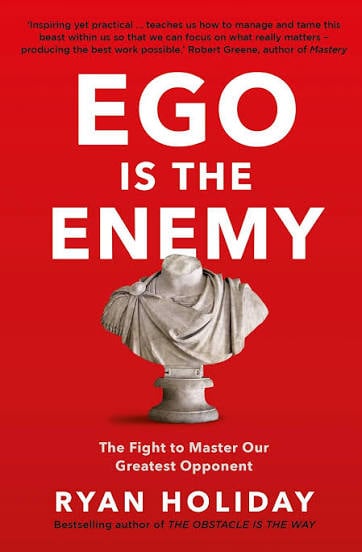
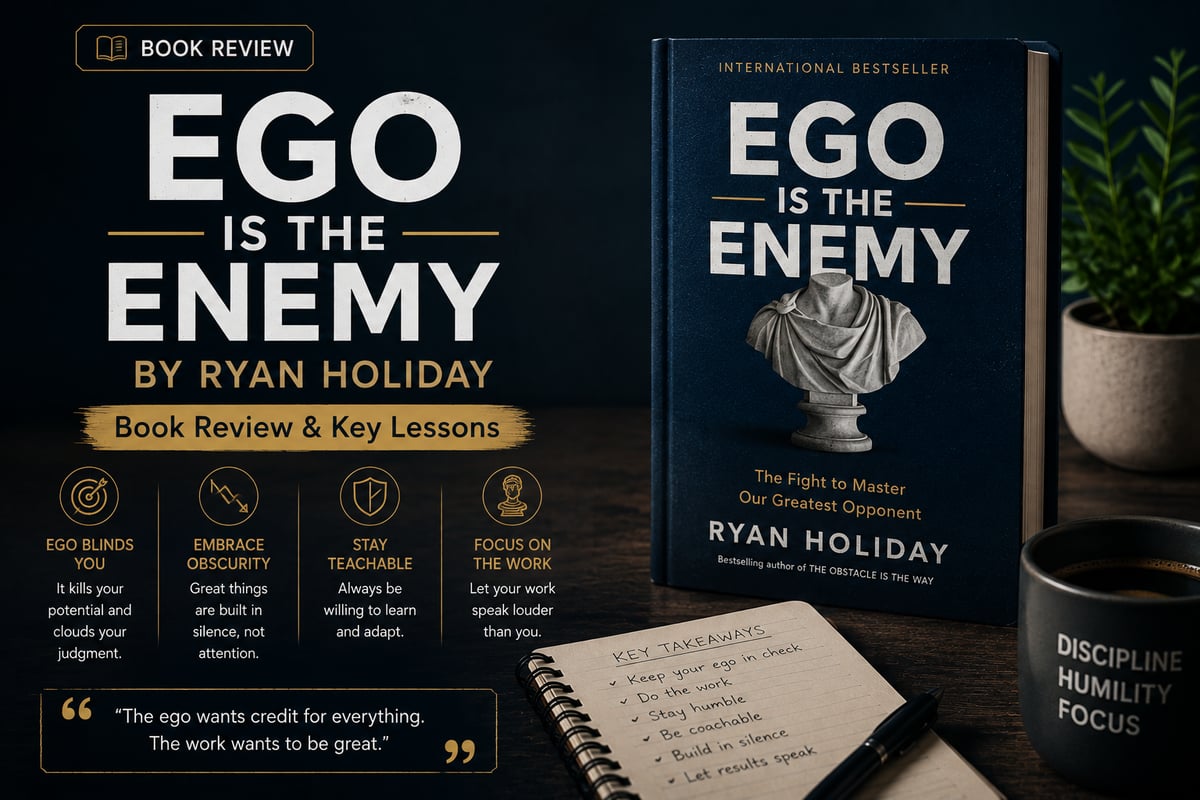
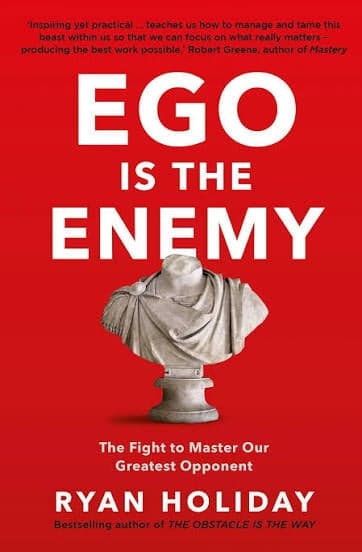
Ryan Holiday's "Ego is the Enemy" is a powerful reminder that our greatest obstacle to success is not external — it's the unchecked ego within us. A must-read…
Ryan Holiday's "Ego is the Enemy" is a powerful reminder that our greatest obstacle to success is not external — it's the unchecked ego within us. A must-read…
This article was written by Sarah Jenkins.
Ego Is the Enemy by Ryan Holiday is a practical exploration of ambition, success, failure, humility, and self-awareness. Published in 2016, the book draws heavily on Stoic philosophy and historical examples to examine a problem that can quietly affect almost anyone: the tendency to become overly attached to our own importance, abilities, image, or achievements.
Holiday's central argument is not that confidence is bad or that people should have low opinions of themselves. Instead, he focuses on the destructive form of ego that makes people believe they are entitled to recognition before they have earned it, resistant to criticism after achieving success, or unable to accept responsibility when things go wrong.
The book is organized around three stages that appear repeatedly throughout life: Aspire, Success, and Failure. This structure makes the book particularly useful because ego does not disappear once someone becomes successful. It simply changes its form.
When we are aspiring, ego can make us talk about our ambitions instead of doing the difficult work required to achieve them. When we succeed, ego can make us believe that past achievements guarantee future success. When we fail, ego can prevent us from honestly examining what went wrong.
The result is a book about much more than humility. It is ultimately about learning how to remain focused on meaningful work while maintaining enough perspective to recognize our limitations.
Carefully selected books for all tastes at the best prices.
At its core, Ego Is the Enemy argues that excessive self-importance can interfere with progress.
Holiday uses "ego" in a specific sense. He is not simply referring to self-esteem or confidence. He is talking about the internal voice that constantly seeks validation, recognition, status, praise, control, and confirmation that we are special.
This kind of ego can appear in surprisingly ordinary situations.
A person may spend more time telling others about a business idea than actually building the business. A talented employee may stop listening to feedback because previous achievements have convinced them that they already know enough. Someone who experiences failure may become so concerned with protecting their reputation that they refuse to acknowledge their mistakes.
In each case, the problem is not ambition itself.
The problem is becoming more concerned with how we appear than with what we are actually doing.
Holiday's solution is to cultivate humility, discipline, continuous learning, and a stronger connection to purpose.
Ryan Holiday is an American author and writer whose work frequently explores Stoic philosophy, strategy, discipline, leadership, and practical approaches to personal development.
His writing often connects ancient philosophical ideas with modern examples from business, sports, politics, military history, and popular culture.
Holiday's approach to Stoicism is particularly practical. Rather than presenting philosophy as an abstract academic subject, he focuses on how philosophical principles can influence everyday decisions.
In Ego Is the Enemy, this approach becomes a framework for examining ambition and achievement.
The book asks readers to consider whether their desire for success is helping them work or simply encouraging them to seek recognition.
Stoicism provides much of the philosophical foundation for the book.
Ancient Stoic thinkers such as Marcus Aurelius, Epictetus, and Seneca emphasized self-control, rational judgment, responsibility, and the importance of distinguishing between what we can control and what we cannot.
This perspective is highly relevant to the problem of ego.
We can influence our actions, preparation, effort, decisions, and responses. We cannot completely control whether other people admire us, whether an opportunity appears, whether a project succeeds, or whether someone gives us the recognition we believe we deserve.
Ego becomes dangerous when we confuse these two categories.
If our happiness depends on external validation, we become vulnerable to circumstances outside our control.
Stoic thinking encourages a different approach: focus on the quality of your actions rather than constantly demanding a particular outcome.
The structure of Ego Is the Enemy revolves around three phases of life.
The first is Aspire.
This is the stage when we are beginning something, developing a career, pursuing an ambition, or trying to become better at a skill.
The second is Success.
This is when our efforts produce results, recognition, money, authority, or status.
The third is Failure.
This is when our plans do not work, circumstances change, or we experience disappointment.
Holiday's important insight is that ego can interfere during all three stages.
The form changes, but the underlying problem remains the same.
The aspiring stage can be deceptively difficult.
When people have a dream, it is tempting to talk about it.
Talking creates a temporary feeling of progress.
You can tell friends about your future company, describe the book you are going to write, explain your fitness plans, or announce your professional ambitions.
The problem is that talking can sometimes substitute for action.
Holiday repeatedly emphasizes the difference between appearing ambitious and actually doing the work.
A person can spend hours discussing their future while making almost no progress toward it.
The solution is relatively simple, although not necessarily easy: work quietly and consistently.
One of the most practical lessons from the book is the importance of reducing unnecessary self-promotion.
When you constantly announce what you are going to accomplish, you may become psychologically satisfied before doing the difficult work.
There is also a social cost.
The more you publicly describe your plans, the more your attention can shift toward protecting the image of someone who is successful.
That can make experimentation more difficult because failure becomes embarrassing.
Working quietly creates more room for mistakes, learning, and improvement.
The goal is not to hide everything.
It is to make sure that communication does not replace execution.
Another important theme is the difference between passion and purpose.
Modern culture often tells people to "follow their passion."
Holiday questions this idea.
Passion can be emotional and unstable. You may feel passionate about something today and lose interest when the work becomes difficult.
Purpose is often more durable.
Purpose asks why the work matters and what contribution you want to make.
Someone who wants to become an excellent writer simply because they want recognition may lose motivation when writing becomes difficult.
Someone who wants to communicate useful ideas to others may have a stronger reason to continue improving even when recognition is absent.
The distinction is subtle but important.
Passion can provide energy.
Purpose can provide direction.
One of the strongest antidotes to ego is remaining willing to learn.
When people become convinced that they already know everything important, improvement slows down.
A student mentality does not require pretending to be incompetent.
It means recognizing that there is always something to learn.
The most useful question is often not "How can I prove that I am right?"
It is "What am I missing?"
This shift can improve professional development, relationships, leadership, and decision-making.
Beginners have one major advantage: they know they do not know everything.
Experienced people sometimes lose that advantage because previous success creates confidence.
A person who has succeeded repeatedly may assume that the next challenge will work the same way.
But new environments require new knowledge.
Technology changes. Markets change. Organizations change. People change.
A method that worked five years ago may no longer work today.
The willingness to become a beginner again can therefore be a significant competitive advantage.
Success can be more dangerous than failure because it creates evidence that supports our ego.
When things go well, people may begin believing that they are unusually talented, intelligent, or special.
Sometimes that belief is partly justified.
The problem begins when success becomes an excuse to stop learning.
Recognition can create entitlement.
Money can create overconfidence.
Authority can reduce exposure to criticism.
Popularity can create the illusion that every opinion is correct.
Holiday argues that the successful stage requires humility precisely because success can make humility more difficult.
Past success is evidence that something worked.
It is not proof that everything you do in the future will work.
This distinction is extremely important.
A successful entrepreneur can make a disastrous investment.
A talented athlete can lose a competition.
A respected manager can make a poor strategic decision.
A famous creator can produce something that audiences dislike.
Success should therefore be treated as information rather than identity.
You succeeded at something.
That does not mean you are incapable of failure.
Entitlement is one of the clearest expressions of ego.
It appears when someone begins believing that they deserve special treatment because of their achievements.
The problem is that other people do not necessarily share this perception.
An employee may believe a promotion is automatically deserved because of past performance. A business owner may believe customers should remain loyal regardless of declining quality. A successful professional may assume colleagues should always accommodate them.
Entitlement can create resentment and weaken relationships.
Humility creates a healthier alternative: appreciate success without assuming that it makes you superior to everyone else.
The moment you stop learning can be the moment your decline begins.
Successful people often have access to more information, resources, and opportunities than before.
But they can also become surrounded by people who hesitate to challenge them.
This creates a dangerous feedback loop.
They make decisions.
People praise those decisions.
They become more confident.
They receive less criticism.
Eventually, they become disconnected from reality.
A student mentality interrupts this cycle.
Seek feedback. Read. Ask questions. Study people who know more than you. Reconsider assumptions.
Success should increase your curiosity rather than decrease it.
Failure presents a different challenge.
When something goes wrong, ego often tries to protect identity.
Instead of asking what happened, we may immediately search for someone to blame.
The customer was wrong.
The manager was unfair.
The market was terrible.
The team did not understand.
The timing was bad.
Sometimes those explanations are accurate.
But if we automatically blame external circumstances, we may miss information that could help us improve.
Failure becomes useful when we can examine it honestly.
Taking responsibility does not mean blaming yourself for everything.
It means separating what was within your control from what was not.
You may not control the market.
You may control how much research you conducted.
You may not control another person's decision.
You may control how clearly you communicated.
You may not control an unexpected event.
You may control how you respond afterward.
This distinction is central to Stoic thinking and extremely useful for personal growth.
Failure can provide information that success cannot.
When everything works, it is difficult to know which assumptions were correct.
When something fails, weaknesses become visible.
A failed project may reveal poor planning.
A rejected application may reveal missing qualifications.
A business mistake may reveal an incorrect understanding of customers.
A conflict may reveal a communication problem.
Failure does not automatically make someone better.
Reflection does.
The value of failure comes from what you learn and what you change afterward.
An important clarification is that humility does not mean thinking poorly of yourself.
Humility means having an accurate view of yourself.
You can recognize your strengths without believing that you are superior to everyone else.
You can be confident without needing constant admiration.
You can acknowledge achievements without making those achievements the foundation of your identity.
Healthy confidence says, "I can learn and improve."
Ego says, "I must prove that I am already great."
That distinction captures much of Holiday's argument.
Although Ego Is the Enemy was published before many of today's most prominent digital habits became deeply embedded in everyday life, its ideas are highly relevant to social media.
Social platforms make public validation extremely easy to measure.
Likes, comments, followers, views, shares, and engagement statistics can become proxies for self-worth.
This creates a difficult psychological environment.
A creator may begin making content because they enjoy creating, but eventually optimize everything for external approval.
The work becomes less about purpose and more about maintaining an image.
Holiday's message provides a useful counterbalance: focus on the work itself rather than becoming psychologically dependent on recognition.
Career growth can create numerous opportunities for ego.
Promotions can change how people see themselves.
Professional titles can become part of identity.
Salary can become a measure of personal worth.
Prestigious employers can become sources of status.
The danger is allowing professional achievements to define your entire identity.
A job can be an important part of your life without being the entirety of who you are.
Keeping perspective can help professionals handle both success and setbacks more effectively.
Leadership provides an especially interesting application of the book's ideas.
A leader who needs to be right all the time creates an environment where employees become afraid to disagree.
That can produce poor decisions because problems are hidden instead of communicated.
A humble leader can say, "I was wrong."
That statement does not necessarily weaken authority.
In many cases, it strengthens credibility because people recognize intellectual honesty.
Good leadership therefore requires confidence combined with openness to correction.
Entrepreneurs face enormous uncertainty.
They must make decisions without having complete information.
This environment can reward confidence, but excessive confidence can become dangerous.
A founder may become emotionally attached to an idea and interpret criticism as a personal attack.
Customers provide negative feedback.
The founder dismisses it.
Sales decline.
The founder blames marketing.
The real problem may be that the product does not solve a sufficiently important problem.
Ego makes it harder to recognize such situations.
Entrepreneurship therefore requires the ability to detach personal identity from individual ideas.
Your idea can be wrong without meaning that you are a failure.
Ego is not limited to professional life.
It can damage friendships, family relationships, and romantic relationships.
People argue because they want to be right.
They refuse to apologize because they believe apologizing means losing.
They interpret criticism as an attack.
They keep score instead of trying to understand.
Humility can change these dynamics.
Sometimes the most productive question is not "Who won the argument?"
It is "What would help this relationship move forward?"
A recurring lesson in Ego Is the Enemy is the value of doing work without constantly seeking recognition.
Quiet work allows you to focus on the process.
You can practice without an audience.
You can experiment without worrying about appearances.
You can make mistakes without publicly defending your reputation.
You can improve before asking the world to notice.
This does not mean that self-promotion is always bad. Visibility can be important for careers and businesses.
The lesson is simply that visibility should follow substance rather than replace it.
The title is intentionally provocative.
Ego is not necessarily the enemy of every ambition.
The enemy is the unhealthy form of ego that interferes with reality.
It is the part of us that wants to be admired more than it wants to improve.
It wants credit before contribution.
It wants success without uncertainty.
It wants to avoid responsibility after failure.
It wants to protect an identity instead of confronting facts.
In that sense, the book is not an argument against ambition.
It is an argument against allowing self-importance to control ambition.
Perhaps the most practical lesson is simple: focus on the work.
Instead of asking whether people recognize your potential, develop your skills.
Instead of constantly discussing your plans, execute them.
Instead of worrying about whether others consider you talented, become better.
Instead of obsessing over status, produce something useful.
The work creates evidence.
Recognition is uncertain.
The work is what you can control.
Praise feels good.
There is nothing inherently wrong with enjoying recognition.
The problem occurs when praise becomes necessary.
If your motivation depends entirely on approval, criticism becomes extremely painful.
You may begin avoiding difficult projects because they carry a risk of failure.
A healthier approach is to appreciate praise without depending on it.
External recognition should be a bonus rather than the foundation of your identity.
Ego can make us uncomfortable around people who are more talented than we are.
Instead of feeling threatened, we can become curious.
Someone who is better at a particular skill represents a learning opportunity.
This approach changes competition into education.
The question becomes:
"What can I learn from this person?"
That question can accelerate development far more effectively than trying to prove that you are equally good.
Success can distort perception.
When everything goes well, it is easy to believe that success will continue indefinitely.
But circumstances change.
Markets change.
Technology changes.
People change.
Competition changes.
The ability to maintain perspective helps prevent temporary success from becoming permanent overconfidence.
Celebrate achievements, but keep learning.
A failed project is not the same thing as a failed person.
A rejected opportunity does not determine your worth.
A career setback does not necessarily predict your future.
Separating events from identity creates psychological space for improvement.
You can say, "This failed," without saying, "I am a failure."
That distinction is powerful.
Ego often wants to announce potential.
Results are quieter.
Instead of explaining how talented you are, produce something valuable.
Instead of repeatedly promising improvement, demonstrate it.
Instead of demanding respect, develop the qualities that naturally create respect.
Results do not eliminate the need for communication, but they provide a stronger foundation for credibility.
Grounded people understand that success is often influenced by multiple factors.
Talent matters.
But timing matters too.
Hard work matters.
But opportunity matters too.
Skill matters.
But relationships, circumstances, resources, and luck can also influence outcomes.
Recognizing these factors does not diminish achievement.
It creates perspective.
One of the book's major strengths is its accessibility.
Holiday takes philosophical ideas and connects them with stories about recognizable historical figures.
This makes abstract concepts easier to remember.
Another strength is the structure.
Dividing the book into aspiration, success, and failure allows readers to see how the same psychological problem can appear at different moments.
The book is also practical.
Rather than simply discussing ego theoretically, it repeatedly asks readers to examine their own behavior.
The book's strongest ideas can sometimes feel repetitive.
Because humility and ego are recurring themes, some readers may feel that certain examples communicate similar lessons.
The historical anecdotes are also presented primarily to illustrate broader principles rather than provide exhaustive historical analysis.
Readers looking for an academic examination of Stoicism may therefore find the approach simplified.
The book is better understood as practical philosophical writing than as a scholarly history of Stoicism.
The book can be useful for almost anyone interested in personal growth, but it may be particularly valuable for people experiencing major transitions.
Students beginning careers can learn why talking about ambition is less valuable than developing skills.
Entrepreneurs can learn why attachment to an idea can interfere with good decisions.
Managers can reflect on how authority affects their willingness to receive criticism.
Creative professionals can examine the relationship between recognition and meaningful work.
People experiencing failure can use the book as a framework for separating identity from outcomes.
One practical way to apply the book is to create a habit of asking yourself uncomfortable questions.
Am I seeking recognition or trying to improve?
Am I listening to criticism or defending myself?
Am I doing the work or talking about doing it?
Am I learning from people who know more than me?
Am I allowing past success to influence my decisions too much?
Am I taking responsibility for what I can control?
These questions can function as a personal check against ego.
Before making an important decision, pause and ask what is actually motivating you.
Do you genuinely believe the decision is useful?
Or do you want to prove something?
Are you choosing a project because it matters?
Or because you want people to admire you?
Are you defending an idea because evidence supports it?
Or because changing your mind would be embarrassing?
This type of self-questioning can reveal motivations that are difficult to see when emotions are high.
Modern culture often rewards visibility.
People are encouraged to build personal brands, display achievements, announce goals, and constantly demonstrate productivity.
There are legitimate benefits to visibility.
However, the constant performance of success can make it difficult to distinguish between achievement and appearance.
Holiday's philosophy provides an important counterbalance.
You do not need to document every accomplishment.
You do not need everyone to know what you are working on.
You do not need to turn every goal into a public performance.
Sometimes the most valuable progress happens when nobody is watching.
Ego Is the Enemy by Ryan Holiday is a thoughtful and practical book about one of the most persistent obstacles to personal and professional development: our tendency to become overly attached to our own importance.
Its central message is simple but difficult to practice.
When you are aspiring, focus on learning and doing rather than constantly seeking recognition.
When you are experiencing success, remain curious, humble, and aware that circumstances can change.
When you encounter failure, resist the urge to protect your ego through excuses and instead search for the lessons hidden inside the experience.
The book's greatest strength is that it does not treat ego as a problem reserved for arrogant people. It presents ego as something that can affect ambitious, talented, successful, and even well-intentioned individuals.
That makes the message much more useful.
You can be ambitious without being obsessed with status. You can be confident without believing you are superior. You can celebrate success without becoming entitled. You can experience failure without allowing it to define you.
Ultimately, Ego Is the Enemy encourages a quieter form of ambition: do the work, keep learning, stay grounded, accept reality, and let your results develop over time.
For readers interested in personal growth, Stoicism, productivity, leadership, entrepreneurship, psychology, and self-improvement, Ryan Holiday's book offers plenty of ideas worth reflecting on.
The most important lesson may be the simplest one: your greatest obstacle is not always the person competing against you. Sometimes it is the version of yourself that needs to be seen as successful before you have finished becoming successful.
Ryan Holiday's central argument is particularly relevant because ego can appear at several different stages of a person's development. It can prevent someone from learning when they are inexperienced, distort judgment when they become successful and make failure more difficult to accept.
What we appreciate most is the book's emphasis on humility as a practical advantage rather than simply a moral virtue. Being willing to listen, accept criticism and recognize what one does not know can improve decision-making considerably.
However, we would add an important nuance: eliminating ego entirely is neither realistic nor necessarily desirable. Confidence, ambition and self-belief can also be useful. The real objective is not to have no ego, but to prevent it from controlling decisions. That distinction makes Holiday's message much more practical.
Be the first to comment!