riwaya.

riwaya.🇲🇦
We use cookies to improve your experience, analyze our traffic, and offer you personalized offers. Learn more in our Privacy Policy.
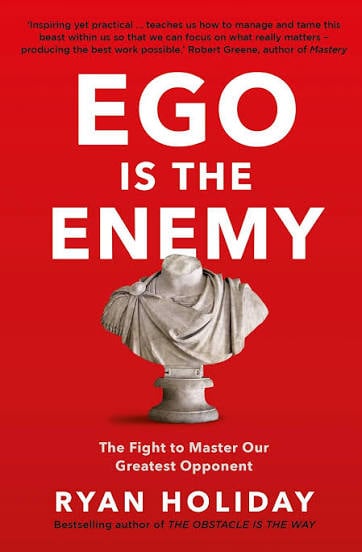
Ryan Holiday
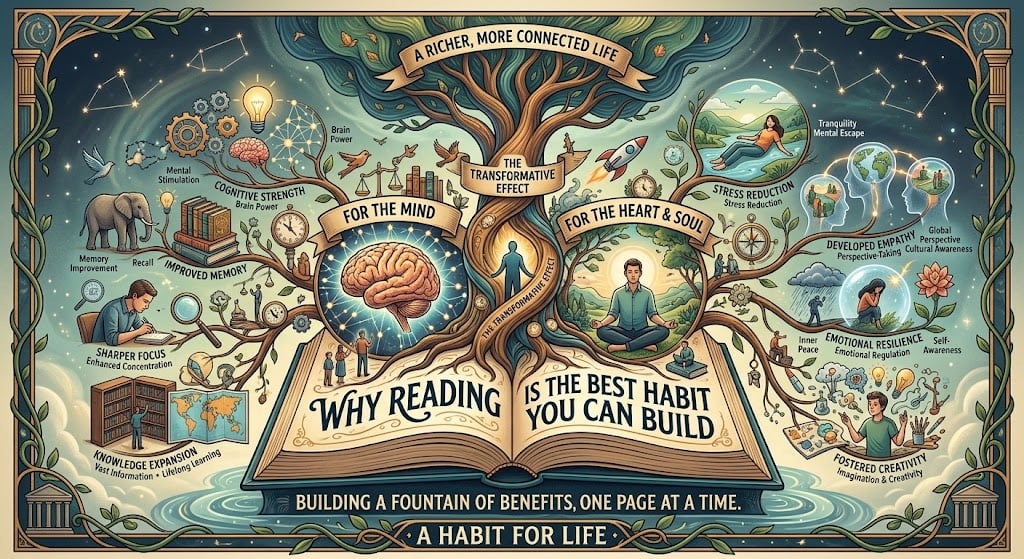
Discover how building a daily reading habit can transform your mind, reduce stress, expand your knowledge, and help you become the best version of yourself — one page at a time.
Discover how building a daily reading habit can transform your mind, reduce stress, expand your knowledge, and help you become the best version of yourself — one page at a time.
This article was written by Sarah Jenkins.
Reading is one of the simplest habits you can introduce into your daily life, yet its effects can extend far beyond the few minutes you spend with a book. Unlike many habits that require expensive equipment, special locations, or significant amounts of time, reading can happen almost anywhere: at home, on a train, during a lunch break, or before going to bed.
A good book can teach you something you did not know, introduce you to a perspective you had never considered, transport you into another culture, or simply give your mind a quiet place to rest. Over time, these small moments accumulate. A few pages today become several books over a year, and several books can gradually influence the way you think, communicate, make decisions, and understand other people.
The real value of reading, however, is not measured by the number of books you finish. Reading is most powerful when it becomes a consistent practice of curiosity. The goal is not to impress others with a reading list, but to develop a mind that remains interested, reflective, and willing to learn.
Carefully selected books for all tastes at the best prices.
When you read, your brain performs several processes simultaneously. It must recognize written symbols, connect them with language, interpret meaning, follow relationships between ideas, and retain enough information to understand what comes next.
Reading therefore requires active mental participation. Unlike passive consumption of rapidly changing content, sustained reading asks you to remain with an idea long enough to understand it. When the material is complex, you must remember previous information, interpret context, compare ideas, and sometimes question the author's assumptions.
This is one reason reading can be viewed as a form of mental training. Just as physical exercise repeatedly challenges the body, demanding books can repeatedly challenge attention, memory, language, and reasoning.
Regular reading can also expose you to a much broader vocabulary than everyday conversation. You encounter unfamiliar expressions, specialized terminology, different writing styles, and ideas that may never appear in your normal environment. With repeated exposure, some of that language becomes part of your own ability to communicate.
Modern life makes sustained attention increasingly difficult. Notifications, short videos, social media feeds, emails, and constant interruptions encourage us to move rapidly from one stimulus to another.
A book offers a different experience. To understand a chapter, you generally have to stay with the same subject for several minutes or longer. You cannot understand a complex argument simply by glancing at one sentence and immediately moving elsewhere.
This makes reading a useful way to practice sustained attention. The important point is consistency rather than duration. Someone who currently struggles to concentrate for ten minutes does not need to begin with an ambitious two-hour reading session.
Starting with ten or fifteen focused minutes can be enough. As the habit becomes familiar, increasing the duration becomes easier. Over time, the ability to remain engaged with a single subject can become useful not only for reading but also for studying, working, writing, and solving complicated problems.
One of the most visible benefits of reading is improved exposure to language. Books introduce readers to words and expressions that they may rarely encounter in ordinary conversation.
Different genres provide different linguistic experiences. Literature can expose you to descriptive language and dialogue. History introduces specialized terminology and contextual vocabulary. Business books may teach concepts related to management and economics. Philosophy encourages precise definitions and abstract reasoning.
The benefit is not simply knowing more words. A larger vocabulary gives you more options when expressing an idea. Instead of relying on the same familiar expression repeatedly, you may become better at choosing language that communicates exactly what you mean.
For students and professionals, this can be particularly valuable. Clear communication is useful in almost every field, whether you are writing an email, preparing a presentation, participating in a meeting, or explaining a complicated idea to another person.
A strong reading habit should not turn you into someone who automatically believes everything written in a book. Quite the opposite: good reading should encourage questioning.
When you encounter an argument, you can ask what evidence supports it, what assumptions it contains, whether alternative explanations exist, and whether the conclusion logically follows from the information presented.
Reading across different perspectives is especially useful. If you read only authors who agree with your existing opinions, your worldview may become narrower rather than broader. Reading different viewpoints gives you opportunities to compare arguments and discover where your own assumptions may be incomplete.
This does not mean accepting every perspective as equally valid. Critical reading means learning to distinguish between evidence, interpretation, opinion, speculation, and unsupported claims.
Curiosity is one of the most valuable qualities a person can cultivate because it encourages continuous learning.
A single book can lead to dozens of new questions. A book about ancient civilizations might make you curious about archaeology. A novel set in another country might make you want to understand its history. A biography might inspire you to investigate an entire field of science, art, politics, or entrepreneurship.
This creates a powerful cycle: reading produces questions, questions create curiosity, curiosity leads to further reading, and further reading deepens understanding.
A person who develops this habit does not need to wait for formal education to learn something new. The world becomes a classroom, and books become one of its most accessible resources.
Fiction has a particular strength: it allows readers to spend time inside stories and perspectives that may be completely different from their own.
A novel can place you in another country, historical period, social environment, or family. Through characters, readers encounter fears, ambitions, mistakes, relationships, conflicts, and moral choices that they may never experience personally.
This can encourage perspective-taking. Instead of thinking about another person only as an abstract category, a reader may begin to understand the complexity of an individual life.
Literary fiction is particularly valuable in this regard, but biographies, memoirs, historical accounts, and narrative nonfiction can also broaden our understanding of people and societies.
Reading is not only an intellectual activity. Stories can also encourage reflection on emotions and relationships.
A well-written character may experience jealousy, grief, ambition, loneliness, love, regret, fear, or hope. As readers follow that character's decisions, they may naturally begin thinking about similar emotions in their own lives.
This does not mean that reading is a substitute for professional psychological care when someone needs it. Books can, however, provide a valuable space for reflection and emotional exploration.
Sometimes a story gives a person language for an experience they could feel but could not previously describe. That recognition can be meaningful because understanding an emotion is often the first step toward thinking about how to respond to it.
One of the greatest advantages of a physical book is that it creates a naturally slower environment.
Your phone can contain messages, social media, news, videos, advertisements, games, and dozens of other distractions. A printed book generally has one primary purpose: reading.
This simplicity can be refreshing.
Replacing even part of your daily scrolling with reading can create a deliberate pause in your routine. Instead of constantly asking what has happened in the last few seconds, you spend time following one idea, one story, or one argument.
The objective should not necessarily be to eliminate technology. Digital tools are extremely useful. The goal is to create a healthier balance between rapid information consumption and slower, deeper engagement.
Many people struggle to disconnect from the day's activities. A consistent reading ritual can help create a transition between active daytime responsibilities and a quieter evening.
Reading a physical book before bed can become a simple signal that the day is coming to an end. Instead of remaining engaged with work messages or endlessly scrolling through social media, you give yourself a defined activity that encourages slower attention.
The choice of material matters. An exciting thriller may keep you awake because you want to discover what happens next, while a calm novel, essay, or familiar book may be more relaxing.
There is no universal bedtime reading formula. The most useful approach is to experiment and discover which type of reading helps you naturally slow down.
Reading does not automatically make someone knowledgeable. The real advantage comes from cumulative learning.
Imagine reading ten pages every day. That is roughly 3,650 pages over a year. Depending on the length of the books, that could represent many complete works.
More importantly, knowledge from different books begins to connect. An idea encountered in one book may suddenly make sense because of something learned months earlier in another. This process creates a network of understanding rather than isolated pieces of information.
This is why reading should be viewed as a long-term investment. You may not notice a dramatic change after one book, but hundreds of reading sessions can gradually transform what you know and how you think.
Building a reading habit does not mean reading the same type of book repeatedly. Variety can make your reading life richer.
Fiction can develop imagination and expose you to different human experiences. History can provide context for the present. Science can explain how the world works. Philosophy can challenge your assumptions. Biography can show how individuals navigated difficult circumstances. Personal development can offer practical frameworks, although those ideas should always be evaluated critically.
Poetry can develop sensitivity to language, while essays can teach you to follow compact arguments. Even books that you ultimately disagree with can be useful if they force you to examine your own position.
A balanced reading diet is therefore often more valuable than chasing a particular number of books.
With millions of books available, choosing what to read can become surprisingly difficult.
Start by identifying your current objective. Are you looking for entertainment, knowledge, professional development, spiritual reflection, historical understanding, or simply an escape from routine?
Then consider the quality of the recommendation. Look at the author's background, the subject of the book, independent reviews, and recommendations from readers whose judgment you trust.
You should also pay attention to your current level of knowledge. A highly technical book may be excellent but inappropriate if you are completely unfamiliar with the subject. Starting with an accessible introduction can make the learning process considerably more enjoyable.
Most importantly, do not feel obligated to finish every book you start. A book can be excellent and still be wrong for you at a particular moment.
The biggest mistake people make when trying to read more is creating an unrealistic goal.
Saying "I will read 50 books this year" may sound motivating, but the number itself does not create a habit. A better strategy is to create a behavior that is easy enough to repeat.
Begin with a small daily target. Ten pages or fifteen minutes can be sufficient. Once reading becomes automatic, you can increase the amount naturally.
The objective during the first weeks is not to prove how much you can read. It is to teach yourself that reading is a normal part of your day.
Small habits are easier to maintain than ambitious routines.
If you read only five pages today, that may seem insignificant. But five pages are better than an abandoned goal that requires an hour and eventually becomes overwhelming.
Once the habit is established, some reading sessions will naturally become longer. You may occasionally read for an hour because the book is fascinating. On busy days, you may read only a few pages.
Consistency matters more than perfection.
One effective way to make reading automatic is to connect it with something you already do.
You could read after breakfast, during a daily commute, after dinner, or immediately before going to bed. The existing routine becomes a reminder for the new behavior.
For example, instead of thinking, "I need to find time to read today," create a rule such as, "After I finish my evening tea, I will read for fifteen minutes."
The more predictable the cue becomes, the less mental effort is required to start.
Convenience matters more than people realize.
If your book is hidden inside a drawer while your phone is sitting next to you, the phone will usually win. Make reading physically easy.
Keep a book beside your bed, on your desk, in your backpack, or in another place where you naturally spend time.
You can also maintain different formats for different situations. A physical book may work best at home, while an ebook or audiobook may be convenient during travel.
The objective is to reduce the distance between wanting to read and actually starting.
A reading list can be useful, but it should not become a source of pressure.
You are allowed to abandon a book that does not interest you. You are allowed to reread an old favorite instead of starting something new. You are allowed to spend an entire month reading one difficult book.
Reading is not a competition.
A person who reads ten books deeply and remembers their important ideas may gain far more from the experience than someone who rushes through fifty books simply to increase a yearly statistic.
You do not need to annotate every page, but recording important ideas can improve retention.
You might write down a sentence that changed your perspective, a question you want to investigate, or a practical idea you want to try.
After finishing a book, consider writing a short paragraph answering three questions: What did I learn? What did I disagree with? What will I do differently because of this book?
This simple reflection turns reading from information consumption into active learning.
Speed is not always a virtue.
Some books are designed to be consumed quickly, while others require careful attention. Philosophy, classical literature, complex history, and technical subjects may reward slower reading.
Rereading a paragraph is not failure. Looking up an unfamiliar concept is not wasted time. Pausing to think about an argument is part of reading.
The purpose of reading is understanding, not simply reaching the final page.
Every reader experiences periods when books feel less interesting.
This does not necessarily mean that your reading habit has failed. Sometimes you are simply tired, distracted, or choosing books that do not match your current interests.
Change genres. Try a shorter book. Return to a favorite author. Read essays instead of a long novel. Listen to an audiobook while walking.
The most important thing is to avoid turning a temporary break into permanent abandonment.
Personal growth is often presented as a dramatic transformation, but meaningful change is usually gradual.
Reading can influence the questions you ask, the vocabulary you use, the assumptions you examine, and the examples you remember when making decisions.
A biography may change how you understand perseverance. A novel may challenge a stereotype. A history book may reveal why a modern conflict exists. A scientific book may completely change how you understand an everyday phenomenon.
The value appears when knowledge moves from the page into your thinking and behavior.
A healthy reading habit should not become a status symbol.
The number of books you have read does not automatically determine your intelligence, wisdom, or character. Someone can read hundreds of books without critically examining any of them.
The better question is not "How many books have you read?" but "What have your books helped you understand?"
Reading becomes meaningful when it produces curiosity, humility, better questions, deeper understanding, and sometimes better decisions.
There is no universally superior format.
Physical books offer a tactile experience and can make it easier to disconnect from digital distractions. Ebooks are portable and allow readers to carry an entire library on one device. Audiobooks can make it possible to consume books while walking, commuting, exercising, or doing household tasks.
The best format is the one that helps you read consistently.
There is also no reason to choose only one. You might read a physical novel at home, use an ebook while traveling, and listen to nonfiction during your commute.
Technology does not have to compete with reading. It can help make reading more accessible.
There is no correct number.
One person may comfortably read five books in a year because they have a demanding schedule. Another may read fifty. Both can have meaningful reading lives.
Instead of setting an arbitrary target, consider measuring consistency. How many days per week do you read? How often do you discover a new idea? How often do you return to something you learned and apply it?
If you enjoy numerical goals, choose one that challenges you without turning reading into a stressful obligation.
Reading more is not always the same as reading better.
Someone who reads quickly but remembers nothing may gain less than someone who reads slowly and reflects deeply. Likewise, reading only subjects you already understand may be comfortable but may not challenge your thinking.
Reading better means choosing books intentionally, paying attention, questioning ideas, connecting information, and reflecting afterward.
The ultimate goal is not to maximize pages. It is to maximize what you take from them.
A practical way to start is to create a simple thirty-day challenge.
During the first week, read for ten minutes a day. Do not worry about how many pages you finish.
During the second week, increase the session to fifteen minutes and keep your book visible throughout the day.
During the third week, add a short reflection after each session. Write down one idea you found useful or interesting.
During the fourth week, experiment with your routine. Try reading at a different time, changing genres, or replacing part of your evening screen time with a book.
At the end of thirty days, evaluate the experience. Which time worked best? Which genres kept you engaged? What prevented you from reading on difficult days?
The answers will help you design a sustainable routine rather than simply completing a temporary challenge.
A good reading list should reflect your interests rather than someone else's definition of success.
You can divide your list into categories such as novels, history, science, biographies, personal development, philosophy, spirituality, and books related to your profession.
It can also be useful to maintain three separate lists: books you want to read soon, books you may read eventually, and books you have already finished.
This prevents your reading queue from becoming an overwhelming collection of hundreds of titles.
Unlike many purchases, the value of a book does not necessarily disappear after you finish it.
A useful idea can influence your decisions for years. A story can remain in your memory for decades. A historical account can change how you understand current events. A biography can become a reference point when you encounter your own difficulties.
Books therefore have an unusual relationship with time. You can finish the physical object in a few hours, but its influence can continue long afterward.
This is what makes reading such a powerful long-term habit.
Reading will not solve every problem in your life, and it should not be treated as a magical shortcut to success. Its value is more realistic and, in many ways, more profound.
A consistent reading habit gives you regular opportunities to learn, reflect, imagine, question, and understand. It can strengthen your relationship with language, expose you to unfamiliar perspectives, and create moments of calm in an increasingly distracted world.
You do not need a huge library. You do not need to read a book every week. You do not need to become a literary expert.
You only need to begin.
Choose one book that genuinely interests you. Put your phone aside for fifteen minutes. Open the first page and start.
Over months and years, those small sessions can become one of the most valuable investments you make in yourself.
At Riwaya, we believe that books are more than objects placed on a shelf. They are opportunities to discover ideas, explore different worlds, understand people, and continue learning throughout life. The best book is not necessarily the most famous one—it is the one that gives you a reason to turn the next page.
We would slightly challenge the idea that reading is automatically the « best » habit for everyone. Exercise, sleep, learning, meaningful relationships and other habits can be equally transformative. What makes reading particularly powerful is its ability to combine several benefits within one activity.
A consistent reading habit can expose someone to ideas they would never encounter through their immediate environment. It can also improve vocabulary, provide entertainment, introduce different perspectives and encourage sustained attention.
For us, the real advantage is not the number of books completed. A person who reads slowly and thinks deeply about one useful book may gain more than someone who races through dozens of titles simply to increase a reading count.
Be the first to comment!