riwaya.

riwaya.🇲🇦
Nous utilisons des cookies pour améliorer votre expérience, analyser notre trafic et vous proposer des offres personnalisées. En savoir plus dans notre Politique de confidentialité.
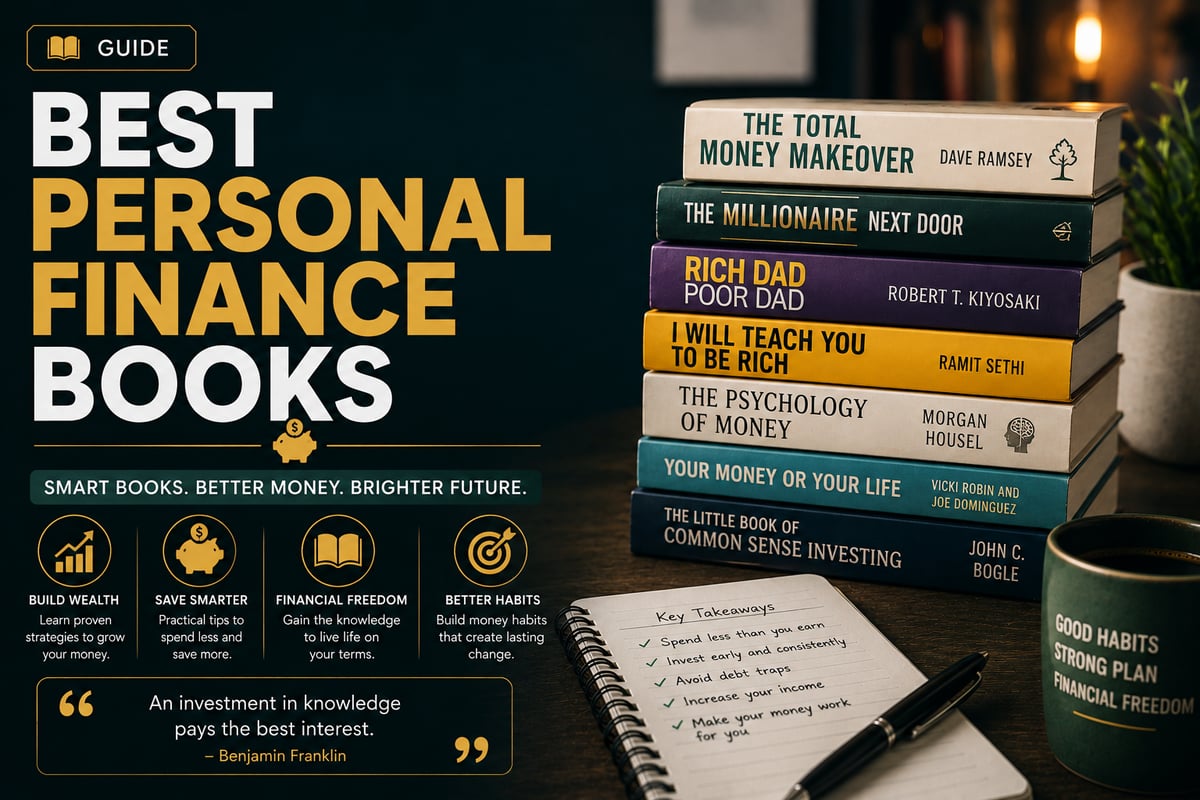
Looking for the best personal finance books to improve your money skills? Discover the most useful titles for budgeting, saving, debt management, investing…
Looking for the best personal finance books to improve your money skills? Discover the most useful titles for budgeting, saving, debt management, investing…
Cet article a été écrit par Amira Lahlou.
Money is one of the most important forces shaping modern life, yet many people reach adulthood without ever receiving a practical education in personal finance. We may spend years learning mathematics, writing, science, technology, or professional skills, but subjects such as budgeting, debt management, investing, financial risk, retirement planning, and wealth building are often left to personal experience.
That creates a difficult situation. People are expected to make important financial decisions about housing, education, credit, insurance, savings, investments, and retirement without necessarily having a framework for evaluating those decisions. A financial mistake made in your twenties can sometimes affect your options for years, while a sensible habit maintained over decades can have an equally powerful positive effect.
The good news is that financial knowledge is learnable. You do not need to become an economist, professional investor, or accountant to understand the fundamentals of managing money. You need a clear framework, reliable information, and enough patience to apply basic principles consistently.
Books can be particularly useful because they provide more context than most short-form financial content. A social media post might tell you to save more, invest in an index fund, avoid debt, or negotiate your salary. A well-developed book can explain why those behaviors matter, what psychological obstacles make them difficult, and how different financial decisions interact with one another.
There is also an important reason not to rely on a single financial philosophy. Personal finance is a broad subject. Budgeting, debt reduction, investing, financial independence, behavioral psychology, entrepreneurship, retirement planning, and risk management are related but distinct areas. A book that is excellent for someone struggling with credit-card debt may be almost irrelevant to an experienced investor.
This guide explores some of the best personal finance books for different situations and levels of experience. Instead of treating every title as equally suitable for every reader, we will examine the central ideas behind each book, its practical strengths, its limitations, and the type of reader who is most likely to benefit from it.
The objective is not to find one perfect book. It is to build a useful financial library that helps you understand money from several complementary perspectives.
Personal finance is ultimately a discipline of decision-making. Every paycheck creates choices about spending, saving, investing, giving, debt repayment, and future goals. Even decisions that appear unrelated to finance can have financial consequences.
A book can help transform isolated decisions into a coherent system. Instead of simply being told to save money, a reader can learn about cash flow, emergency reserves, opportunity cost, compound growth, behavioral biases, and the relationship between present consumption and future flexibility.
This broader context matters because financial problems are rarely caused by a complete lack of information. Many people already know that saving is generally beneficial or that expensive debt can be dangerous. The harder question is how to turn that knowledge into sustainable behavior.
Books are also useful because they encourage slower thinking. Financial markets move quickly, social media rewards dramatic predictions, and online discussions often focus on short-term results. A book gives the reader an opportunity to step away from that environment and consider principles that may remain relevant for years.
Another advantage is exposure to different perspectives. One author may emphasize simplicity and low-cost investing, another may focus on behavior, another on debt elimination, and another on financial independence. Comparing these perspectives can be more educational than treating any individual author as an unquestionable authority.
At the same time, books should be treated as educational resources rather than personalized financial instructions. A recommendation that makes sense for a U.S. household may not apply directly to a reader in Morocco, Canada, France, the United Kingdom, or another country. Tax rules, retirement accounts, investment products, consumer-credit regulations, currencies, insurance systems, and housing markets differ substantially.
The most valuable financial books therefore do more than provide instructions. They teach readers how to think about financial decisions.

Morgan Housel's The Psychology of Money is one of the strongest starting points for readers who want to understand why financial outcomes are influenced by behavior as much as by mathematics.
The central premise is straightforward: people do not make financial decisions purely through rational calculations. Their decisions are shaped by personal history, family experiences, social expectations, emotions, incentives, uncertainty, and their perception of risk.
This idea explains why two people with similar incomes can have completely different financial lives. One may prioritize security and maintain a large cash reserve, while another may be comfortable taking substantial investment risk. Neither person's preferences necessarily come from ignorance. They may simply have different experiences and different definitions of financial success.
One of the book's most useful themes is the importance of understanding the role of luck and risk. Financial outcomes are not always a perfect measure of skill. A successful investment can benefit from favorable circumstances, while a poor outcome can occur even when a reasonable decision was made.
This perspective encourages humility. It is dangerous to assume that someone who became wealthy through a particular strategy necessarily possesses a repeatable formula for everyone else. The same strategy may involve risks that were invisible in hindsight.
Housel also explores the idea of knowing when you have enough. This is particularly relevant in a world where higher income can easily lead to higher consumption. If every increase in earnings produces an equivalent increase in lifestyle costs, earning more may not create much additional financial freedom.
The book is less about constructing a detailed household budget and more about developing a durable mental framework. It can be especially valuable for readers who understand basic financial concepts but find themselves struggling with comparison, fear, greed, impatience, or unrealistic expectations.
Best for: Readers interested in financial behavior, risk, long-term thinking, wealth, and the emotional side of money.
The Richest Man in Babylon takes a very different approach. Rather than presenting modern financial terminology, George S. Clason uses short stories set in ancient Babylon to communicate basic principles about saving, spending, debt, and wealth accumulation.
The simplicity of the book is one of its main strengths. The lessons are designed to be memorable rather than technically sophisticated. Ideas such as saving part of your income, controlling unnecessary expenses, seeking ways to improve earning power, and putting accumulated money to productive use appear repeatedly.
The historical setting is obviously very different from modern financial life. Readers should not treat the stories as a literal guide to today's banking system, investments, taxes, or retirement planning.
Nevertheless, the behavioral principles remain surprisingly durable. Someone who consistently spends every amount they earn will generally struggle to accumulate financial reserves regardless of income level. Someone who develops a habit of saving and investing a portion of their resources has a greater opportunity to build financial resilience over time.
The book is therefore particularly effective for beginners. It does not require a detailed understanding of financial markets or accounting. Instead, it introduces a small number of principles that can become the foundation for more advanced financial education.
Its greatest value may be its ability to make basic financial habits feel concrete. Financial independence does not usually begin with a sophisticated investment strategy. It often begins with the simple ability to create a gap between income and spending.
Best for: Beginners who want an accessible introduction to saving, spending discipline, and wealth-building habits.
Rich Dad Poor Dad is one of the most recognizable books in personal finance. Robert Kiyosaki uses contrasting financial philosophies to encourage readers to question conventional assumptions about employment, income, assets, liabilities, and wealth.
One of the book's most influential ideas is that earning a salary is not the only way to think about financial progress. Kiyosaki encourages readers to develop financial literacy and to understand how assets, expenses, income, and cash flow interact.
The book can be especially motivating for people who have never thought seriously about the distinction between earning money and building wealth. It introduces concepts such as entrepreneurship, cash flow, investing, and the possibility of creating income from assets.
Its greatest strength is arguably its ability to change the questions readers ask. Instead of asking only, "How can I earn a higher salary?" a reader may begin asking, "How can I increase my financial resilience?" or "How can I make better use of the money I already earn?"
However, the book should be approached critically. Some of its concepts are simplified for a general audience, and its definitions do not always correspond precisely to professional accounting terminology. Real estate, entrepreneurship, and investing also involve significant risks that can be understated when financial success is presented primarily through successful examples.
The book is therefore best used as a source of perspectives rather than as a step-by-step investment manual. Readers can benefit from its emphasis on financial education while independently verifying specific investment or business decisions.
Best for: Readers who want to challenge traditional assumptions about employment, income, assets, entrepreneurship, and wealth.
The Total Money Makeover is primarily focused on debt reduction, spending discipline, and building a structured financial foundation.
Its appeal comes from its simplicity. People who are overwhelmed by multiple debts, irregular spending, or a lack of financial organization can benefit from having a defined sequence of priorities rather than attempting to optimize every financial decision simultaneously.
The book emphasizes behavior and commitment. This is important because a technically sophisticated financial plan is useless if a person cannot follow it consistently.
Debt repayment is also a useful starting point for many households because high-interest debt can consume cash flow that could otherwise be used for savings or investing. Understanding the actual interest cost of debt can help people recognize why minimum payments alone may keep a balance outstanding for a long period.
Some of Ramsey's recommendations are deliberately conservative and may not be appropriate for every household. Different readers may have different needs for emergency savings, different borrowing costs, different employer benefits, and different investment opportunities.
The book's strongest contribution is therefore its emphasis on organization and behavioral consistency. Readers can take the general principles while adapting specific decisions to their own circumstances.
Best for: Readers who need a structured approach to spending control, debt reduction, and financial organization.
Ramit Sethi's I Will Teach You to Be Rich focuses on creating practical financial systems rather than obsessing over every individual purchase.
This distinction is valuable. Personal finance can become exhausting when every coffee, meal, subscription, or small purchase is treated as a major financial crisis. A sustainable system should protect important financial goals while still allowing room for spending on things that genuinely matter to you.
Automation is a central theme. Saving and investing can be easier to maintain when transfers happen automatically rather than requiring a fresh decision every month.
The book also encourages readers to understand their accounts, reduce unnecessary fees, negotiate selected expenses, and consciously decide what they want their money to accomplish.
Another useful concept is the idea that not every category of spending deserves the same level of scrutiny. Someone may spend very little on transportation but place significant value on travel, education, restaurants, hobbies, or experiences. A useful financial system should reflect personal priorities rather than forcing everyone into an identical lifestyle.
The account-specific recommendations in the book are primarily designed around the U.S. financial system, so international readers should translate those recommendations into the products, tax rules, and financial institutions available in their own countries.
Best for: Readers who want a practical system for automating saving, spending, and investing without tracking every expense obsessively.
Your Money or Your Life asks a question that traditional financial advice sometimes overlooks: what are you actually exchanging for the money you earn?
The authors introduce the concept of thinking about money in terms of life energy. A salary is not simply an amount deposited into an account. Earning it requires time, attention, transportation, stress, professional effort, and other resources.
This perspective can fundamentally change how someone evaluates spending. A purchase may appear inexpensive when viewed only in monetary terms but look very different when considered in relation to the time required to earn the money.
The book is especially relevant to readers interested in financial independence. It challenges the assumption that higher income and higher consumption must always move together.
One of its strongest ideas is that financial planning should ultimately support a meaningful life. Saving and investing are tools, not purposes in themselves. Money can create security and options, but those options are valuable because they allow people to make choices about how they use their time.
The book can be particularly useful for people who earn a reasonable income but feel that their lifestyle has become increasingly demanding. It encourages readers to examine whether additional spending genuinely improves their lives.
Best for: Readers interested in financial independence, intentional spending, lifestyle design, and greater control over their time.
The Simple Path to Wealth focuses heavily on long-term investing and the importance of keeping an investment strategy understandable.
One of its central ideas is that investing does not necessarily require constant market analysis, frequent trading, or the ability to identify the next successful company.
The book is strongly associated with low-cost index investing. The broader philosophy emphasizes diversification, relatively low investment costs, patience, and a long-term perspective.
This is particularly useful for beginners because financial markets can appear much more complicated than they need to be. Investors encounter thousands of stocks, funds, financial products, strategies, forecasts, and opinions. Complexity can create the false impression that successful investing requires constant activity.
In reality, one of the challenges of investing is often staying disciplined. A strategy that looks sensible during calm markets can become difficult to maintain when prices fall sharply and financial news becomes pessimistic.
The book should nevertheless be adapted to the reader's circumstances. Asset allocation, taxes, currencies, investment accounts, inflation, retirement systems, and available funds differ by country. A U.S.-oriented implementation should not automatically be copied by someone living elsewhere.
Best for: Beginners and intermediate investors who want to understand the philosophy of simple, diversified, long-term investing.

The Millionaire Next Door challenges the popular image of what wealth looks like.
The book examines patterns among financially successful households and emphasizes behaviors such as controlled consumption, saving, investing, and avoiding unnecessary displays of status.
Its central insight is highly relevant in an era of social media: visible consumption is not the same thing as financial wealth.
An expensive vehicle may indicate that someone owns an expensive vehicle. It does not necessarily indicate that the person has a large net worth, substantial savings, or financial security.
This distinction matters because modern consumers are constantly exposed to curated images of lifestyles. Social comparison can create pressure to purchase things that communicate success without actually improving long-term financial stability.
The book's underlying message is that wealth accumulation is often less visible than wealth consumption. Money that is saved and invested may not produce an immediate visual signal, but it can gradually increase financial resilience.
Readers should remember that the research reflects particular populations and periods and should not be treated as a universal statistical description of every wealthy household.
Best for: Readers who want to understand the relationship between lifestyle, consumption, saving, and long-term wealth accumulation.
The Intelligent Investor is a classic investing book associated with value investing and disciplined decision-making.
Benjamin Graham's work is substantially more technical than many of the beginner-friendly books on this list. It explores the difference between investing and speculation, the importance of valuation, diversification, and the concept of a margin of safety.
One of Graham's most influential ideas is that investors should not allow market prices to dictate their emotions. Markets can move significantly even when the underlying value of an investment has not changed proportionally.
The book also encourages investors to distinguish between the price someone is currently willing to pay and the fundamental value they believe an asset represents.
However, this is not necessarily the best first investing book for a complete beginner. Some sections require patience and familiarity with financial concepts, and aspects of Graham's original framework reflect market conditions and investment products from earlier periods.
Modern readers should therefore understand the principles without assuming that every historical example or specific technique should be applied unchanged.
The book is most valuable as a study of investment philosophy, discipline, valuation, and risk rather than as a collection of predictions.
Best for: Intermediate and advanced readers who want to study value investing and disciplined investment decision-making.
A Random Walk Down Wall Street provides a broad introduction to financial markets and explores the difficulty of consistently predicting which investments will outperform.
The book is particularly valuable for readers who are tempted by market forecasts, financial television, stock-picking stories, or promises of easy returns.
Malkiel explains why markets are difficult to predict and why professional expertise does not automatically guarantee superior investment results after accounting for costs, risks, and consistency.
For ordinary investors, the practical implication is significant. Instead of trying to identify every future market winner, an investor may prefer a diversified strategy with reasonable costs and a long time horizon.
The book also introduces readers to several important investment concepts, including diversification, asset allocation, market behavior, and the relationship between risk and expected return.
Its broader contribution is teaching skepticism. Investors should be cautious when someone claims to know exactly what the market will do next.
Best for: Readers who want a broad introduction to markets and the challenges of long-term investing.
The Automatic Millionaire focuses on one of the simplest but most powerful concepts in personal finance: automation.
The basic problem is easy to understand. Many people intend to save whatever remains at the end of the month, but spending naturally tends to absorb available money.
Automation changes the sequence. Instead of saving whatever happens to remain, a person can arrange for part of their income to move toward savings or investments before discretionary spending takes place.
This reduces dependence on motivation and willpower.
Automation can be applied to many financial objectives. It can support an emergency fund, a long-term investment account, a major purchase, debt repayment, or other predefined goals.
The broader lesson is that good financial behavior becomes easier when the environment is designed to support it. A system that works automatically can be more reliable than a plan that requires constant attention.
The concept does not mean that automation solves every financial problem. Income instability, irregular expenses, insufficient emergency savings, and expensive debt still require active decisions. But automation can make healthy habits easier to maintain once the underlying plan is appropriate.
Best for: People who know what they should do financially but struggle with consistency.
Broke Millennial is aimed particularly at younger adults who are learning to manage money independently.
Its accessible approach can make subjects such as budgeting, credit, debt, investing, and financial conversations less intimidating.
This is important because financial terminology itself can become a barrier. Someone who feels embarrassed about not understanding credit scores, interest rates, retirement accounts, or investment terminology may delay learning rather than ask questions.
A beginner-friendly book can help normalize that learning process.
The book is also useful because financial adulthood involves more than spreadsheets. People have to discuss money with partners, family members, landlords, employers, lenders, and sometimes friends.
Financial confidence does not mean knowing everything. It means being willing to ask questions, verify information, understand basic concepts, and make decisions deliberately.
As with other books designed around a specific financial system, readers should adapt product-specific advice to their own country.
Best for: Young adults and beginners who want an approachable introduction to everyday personal finance.
The Little Book of Common Sense Investing presents a straightforward argument for low-cost index investing and emphasizes the long-term importance of minimizing unnecessary investment costs.
John C. Bogle, the founder of Vanguard, was a major advocate of low-cost investing. His philosophy centers on the idea that investors should be careful about fees, unnecessary trading, and strategies that make investing more complicated than necessary.
Costs matter because investment expenses reduce the portion of returns that remains with the investor. Over a long period, recurring costs can have a meaningful effect on accumulated wealth.
The book also emphasizes patience. Investing is not necessarily about predicting every economic cycle or finding the perfect moment to enter the market.
For many long-term investors, the greater challenge is maintaining a sensible strategy through periods of uncertainty.
The book is particularly useful for readers who are beginning to wonder whether investing must involve frequent trading or complicated security selection.
Best for: Beginners who want to understand the philosophy behind low-cost, diversified index investing.
Think and Grow Rich occupies a different category from most of the books in this guide.
It is primarily a motivational work focused on ambition, persistence, goal-setting, and beliefs about achievement rather than a technical personal finance manual.
Its historical influence is considerable, and many readers find its emphasis on clearly defined goals and persistence motivating.
However, it should not be treated as scientific evidence that positive thinking alone creates wealth.
Financial outcomes are influenced by numerous factors, including skills, education, economic conditions, access to opportunities, family circumstances, geography, health, economic cycles, and luck.
This distinction is important because motivational messages can become harmful when they imply that every financial outcome is simply a consequence of individual mindset.
Used appropriately, the book can complement practical financial education. Motivation can help someone take action, while financial knowledge can help determine whether that action is sensible.
Best for: Readers looking for motivation, goal-setting ideas, persistence, and a classic perspective on achievement.
The Behavior Gap focuses on one of the most important challenges faced by investors: the tendency to make poor decisions at emotionally difficult moments.
Carl Richards explores how investors can buy when markets are rising because they feel confident and then sell after markets decline because fear takes over.
This creates a problem because investment returns and individual investor outcomes can differ. A sound long-term strategy may produce disappointing personal results if an investor repeatedly abandons it during periods of stress.
The book encourages readers to understand their own behavior and establish a financial plan they can realistically follow.
This may involve identifying appropriate levels of risk, establishing clear objectives, limiting unnecessary financial decisions, and avoiding constant reactions to market headlines.
The concept extends beyond investing. People can also experience behavioral gaps in spending, debt repayment, savings, and lifestyle decisions.
Knowing the ideal behavior is one thing. Designing a system that makes that behavior sustainable is another.
Best for: Investors who understand basic financial concepts but struggle with emotional decision-making.
Beginners generally benefit most from books that explain financial concepts without assuming extensive prior knowledge.
A useful starting point is The Psychology of Money because it provides a framework for thinking about behavior, risk, expectations, and long-term decision-making.
The Richest Man in Babylon is another accessible option for readers who want simple lessons about saving and controlling spending.
For younger adults who are beginning to manage money independently, Broke Millennial can provide a more practical introduction to everyday financial issues.
Readers who want to create systems around their money may prefer I Will Teach You to Be Rich, while those who need stronger debt and spending discipline may find The Total Money Makeover more relevant.
The important point is that beginners do not need to start with advanced investing literature. Understanding cash flow, emergency savings, debt, spending, and financial goals creates the foundation for more advanced topics.
Debt should be evaluated according to its cost, purpose, structure, and impact on cash flow.
High-interest consumer debt can be particularly damaging because interest charges can consume a substantial portion of monthly payments.
Readers dealing with debt may therefore benefit from books that emphasize organization and repayment discipline before focusing heavily on investment optimization.
The Total Money Makeover is designed around a structured debt-reduction philosophy. Its approach is intentionally simple and behavior-oriented.
Other books, including I Will Teach You to Be Rich, provide broader financial systems that can help readers understand cash flow, automate financial priorities, and make intentional spending decisions.
Regardless of the book chosen, readers should understand the actual terms of their debt. Interest rates, minimum payments, fees, repayment periods, and penalties matter more than motivational slogans.
Saving is one of the simplest financial concepts and one of the hardest behaviors to maintain consistently.
The Richest Man in Babylon provides memorable lessons about consistently setting aside part of your income.
The Automatic Millionaire approaches the problem through automation, reducing the number of decisions required to save.
I Will Teach You to Be Rich adds a broader framework for organizing accounts and financial priorities while still allowing room for conscious spending.
A good savings strategy should also distinguish between different objectives. An emergency reserve serves a different purpose from a down-payment fund, a short-term purchase fund, or long-term retirement investments.
Keeping these goals separate can make financial planning easier because the time horizon and acceptable level of risk may differ for each objective.
Readers interested in investing should first understand the difference between investing and speculation.
Investing involves accepting uncertainty while allocating capital toward assets with the expectation of generating a return over time. Speculation can involve a greater emphasis on short-term price movements and predictions.
The Little Book of Common Sense Investing is useful for understanding the philosophy of low-cost index investing.
The Simple Path to Wealth provides another accessible perspective on simple, diversified, long-term investing.
A Random Walk Down Wall Street offers a broader explanation of markets and the difficulty of consistently outperforming them.
For readers who want to study investment philosophy in greater depth, The Intelligent Investor explores concepts such as valuation, diversification, risk, and the margin of safety.
These books do not eliminate investment risk. Markets can fall, individual investments can lose value, and historical performance does not guarantee future results.
Financial independence is not simply about becoming wealthy. It is about creating enough financial flexibility that money becomes less restrictive.
Your Money or Your Life is particularly relevant because it connects financial decisions with time and personal priorities.
The Psychology of Money also provides useful ideas about the relationship between wealth, lifestyle inflation, enough, and personal freedom.
The Simple Path to Wealth can complement these perspectives by focusing more heavily on long-term investing.
A financial independence strategy should not be reduced to an arbitrary savings percentage. Household circumstances differ. Someone supporting a family, dealing with variable income, living in an expensive city, or managing significant obligations may have a very different path from a single person with low fixed expenses.
The useful question is not simply how quickly someone can stop working. It is how financial resources can gradually increase the number of choices available.
Money is deeply emotional.
People may associate spending with pleasure, saving with security, investing with fear, debt with shame, and wealth with social status. These emotional associations can influence decisions even when someone understands the mathematics.
The Psychology of Money is perhaps the clearest recommendation for this category.
The Behavior Gap provides a complementary perspective focused particularly on investment behavior.
The Millionaire Next Door adds another dimension by examining how social expectations and visible consumption can differ from actual financial wealth.
Together, these books demonstrate an important principle: improving financial outcomes often requires changing behavior, not simply acquiring more information.
Long-term wealth building usually depends on a combination of income, savings, investment returns, risk management, time, and behavior.
No single book covers every component perfectly.
The Richest Man in Babylon emphasizes the habit of saving.
The Millionaire Next Door examines disciplined consumption and accumulation.
The Simple Path to Wealth focuses more directly on long-term investing.
The Psychology of Money explores the behavior required to remain patient over long periods.
These perspectives can be combined into a simple framework: create a sustainable gap between income and spending, protect yourself against financial shocks, invest according to your circumstances, control unnecessary costs, and allow time to work.
The best personal finance book for you depends on the problem you are currently trying to solve.
If your biggest challenge is uncontrolled spending, begin with a book about behavior, budgeting, or financial systems rather than an advanced investment guide.
If you have expensive debt, prioritize debt management and cash-flow organization.
If you already have a stable financial foundation and want to learn about investing, books about diversification, fees, risk, market behavior, and long-term strategy become more relevant.
If you are financially comfortable but dissatisfied with your lifestyle, Your Money or Your Life or The Psychology of Money may be more useful than another technical investing book.
Your experience level matters as well. An advanced investment book can be valuable, but reading it too early may create unnecessary confusion.
A good financial education should progress from fundamentals to more specialized subjects.
A beginner does not need to read twenty financial books. Three or four carefully selected books can be more useful than a large collection that is never applied.
A sensible starting point is The Psychology of Money. It helps establish a behavioral framework and encourages readers to think about risk, time, expectations, and financial goals.
Next, choose a practical book based on your situation. Someone with debt may prefer The Total Money Makeover. Someone looking for an automated financial system may prefer I Will Teach You to Be Rich. Someone interested in intentional living may choose Your Money or Your Life.
After establishing basic financial habits, move toward investing. The Simple Path to Wealth, The Little Book of Common Sense Investing, and A Random Walk Down Wall Street provide different perspectives on long-term investment principles.
Finally, consider more demanding works such as The Intelligent Investor if you want to study investment philosophy in greater depth.
This sequence prevents a common mistake: learning how to analyze investments before learning how to manage the money that will eventually be invested.
A financial book can contain valuable ideas without being correct in every detail.
Authors have different backgrounds, incentives, assumptions, and audiences. Some write primarily for beginners, others for experienced investors. Some emphasize conservative financial behavior, while others are more comfortable with entrepreneurship or investment risk.
Readers should therefore separate principles from prescriptions.
A principle might be that investment costs matter. A prescription might be a specific fund, account, or portfolio allocation.
The principle may remain broadly useful even if the specific product is unavailable or inappropriate in your country.
Readers should also distinguish between historical examples and universal rules. A strategy that worked during one economic period may not produce the same results under different market conditions.
Finally, be cautious with certainty. Financial markets contain genuine uncertainty, and no responsible author can guarantee a particular investment return.
The strongest books usually improve your ability to reason rather than simply giving you a list of commands.
Personal finance books often reflect the financial systems of the countries where they were written.
A book written for American readers may discuss retirement accounts, tax structures, credit products, insurance systems, or investment vehicles that work differently elsewhere.
For readers in Morocco, for example, local taxation, banking products, real estate conditions, pension arrangements, investment regulations, currency considerations, and available financial institutions need to be evaluated separately.
The same principle applies internationally.
A book can teach you why diversification matters without telling you exactly which investment product you should buy.
It can explain compound growth without determining which account is appropriate for your circumstances.
It can encourage emergency savings without telling you the precise amount your household requires.
This is why financial books are best viewed as educational frameworks. Before acting on a recommendation involving significant money, verify the relevant local rules and product information.
Books cannot know your complete financial situation.
An author does not know your income, expenses, family responsibilities, debt obligations, employment stability, financial goals, insurance coverage, tax residency, or risk tolerance.
This limitation is particularly important when applying investment advice.
No book can reliably predict the next stock-market movement, recession, interest-rate decision, currency movement, or investment winner.
Likewise, a book cannot guarantee that a particular business idea, property investment, or entrepreneurial strategy will succeed.
Financial education should therefore increase independence rather than create dependence on an author.
The goal is to become capable of evaluating financial information yourself.
Reading alone does not improve your finances. Application does.
After finishing a chapter or book, identify the ideas that are genuinely relevant to your situation.
For example, if you learn about emergency savings, calculate how much accessible cash you currently have.
If you read about spending behavior, examine your transactions from the previous month.
If you learn about investment fees, investigate the actual costs associated with the products available to you.
If you learn about debt, calculate how much interest you are paying and how long repayment could take under different payment amounts.
The key is to turn abstract concepts into measurable actions.
However, avoid changing your entire financial system overnight. Implementing one or two sustainable improvements is often more realistic than attempting a complete financial transformation in a single weekend.
A useful reading habit is to keep a personal finance notebook. Record important concepts, questions, decisions, and lessons from different authors.
Over time, you can compare ideas and build your own financial framework.
One common mistake is assuming that higher income automatically produces wealth.
Higher income creates more possibilities, but lifestyle inflation can consume much of the additional money.
Another mistake is focusing on investing while ignoring financial stability.
A household with expensive debt, no emergency reserve, and unstable cash flow may have different priorities from someone with stable income and substantial savings.
Chasing unusually high returns is another major risk.
Investment opportunities that promise exceptional returns with little or no risk should receive careful scrutiny. Higher potential returns generally come with greater uncertainty, greater risk, a longer time horizon, or some combination of these factors.
Another mistake is copying wealthy people without understanding how they became wealthy.
A strategy that worked for an entrepreneur, professional investor, or business owner may involve circumstances that an ordinary household cannot reproduce.
Finally, avoid treating financial influencers, authors, or successful investors as infallible authorities.
Good financial education should make you more skeptical, not less.
Knowing financial terminology is not the same as being financially capable.
Someone may understand compound interest perfectly and still fail to maintain an emergency fund.
Someone may understand diversification but panic during a market decline.
Someone may know that debt is expensive but continue using credit because their spending system is poorly designed.
Financial skill is the ability to apply knowledge consistently.
This is why many of the strongest personal finance books focus on behavior, habits, systems, and decision-making rather than mathematics alone.
The practical objective is not to know every financial concept. It is to know enough to make sound decisions, recognize risks, ask better questions, and avoid preventable mistakes.
Compound growth is one of the most important concepts in long-term personal finance.
When money generates returns and those returns remain invested, future growth can occur on both the original amount and previous gains.
This means time can become an important advantage.
However, compound growth should not be presented as a guarantee. Investment returns vary, markets fluctuate, and inflation affects purchasing power.
The practical lesson is that long-term financial planning should generally take time into account. Starting early can give savings and investments more years to potentially grow, while delaying financial decisions can reduce the amount of time available.
This is one reason many personal finance books emphasize consistency rather than dramatic short-term results.
Emergency savings are not designed primarily to maximize returns. Their purpose is resilience.
Unexpected expenses can include medical costs, repairs, temporary unemployment, family emergencies, or other events that disrupt normal cash flow.
Without accessible savings, an unexpected expense may force someone to use expensive credit or sell investments at an unfavorable moment.
The appropriate size of an emergency reserve depends on circumstances. Someone with stable employment and low fixed expenses may have different needs from a household with variable income, dependents, or substantial financial obligations.
The important principle is to recognize that financial planning should include protection against uncertainty, not merely the pursuit of higher returns.
Diversification is another recurring theme in investment literature.
The basic idea is that concentrating too much wealth in one investment, company, sector, property, or other asset can expose an investor to substantial risk if that particular asset performs poorly.
Diversification cannot eliminate market risk. A broadly diversified portfolio can still decline in value.
What diversification can do is reduce the dependence of the overall outcome on a single investment.
The appropriate degree and method of diversification depend on the investor's circumstances, time horizon, risk tolerance, and available products.
The important lesson for readers is not that diversification guarantees profits. It is that managing concentration risk can be an important part of responsible investing.
Investment costs are easy to overlook because they may appear small when expressed as annual percentages.
However, recurring fees can affect the amount of money that remains invested and therefore the amount available for future growth.
This is one of the major themes in John Bogle's investment philosophy and is also relevant when comparing investment products.
Investors should consider management fees, transaction costs, account charges, spreads, taxes, and other expenses where applicable.
The lowest-cost product is not automatically the best product in every situation. Investors should also consider diversification, liquidity, structure, regulatory status, risk, and suitability.
Nevertheless, understanding costs is an essential part of evaluating an investment.
Financial independence does not have one universal definition.
For one person, it may mean having enough savings to handle unexpected expenses without relying on debt.
For another, it may mean having enough invested assets to reduce dependence on employment income.
For someone else, it may mean having the flexibility to work fewer hours, change careers, start a business, or spend more time with family.
This is why personal finance should begin with goals rather than numbers alone.
A financial plan should answer a basic question: what do you want money to make possible?
Without that question, wealth accumulation can become an endless process where the target constantly moves upward.
There is no ideal number.
Reading ten books that repeat the same basic ideas may add less value than reading three books that approach the subject from different perspectives.
A useful strategy is to choose books that fill different educational gaps.
For example, one book might teach financial psychology, another debt management, another long-term investing, and another financial independence.
This creates a broader framework without requiring an enormous reading list.
Readers should also recognize diminishing returns. Once you understand the fundamentals, repeatedly consuming financial content can become a substitute for taking action.
At some point, the next useful step is not another book. It is implementing what you have already learned.
For understanding financial behavior and the psychology of money, The Psychology of Money is one of the strongest choices.
For a simple introduction to saving and basic wealth-building habits, The Richest Man in Babylon remains accessible and memorable.
For readers interested in questioning traditional assumptions about work, assets, and income, Rich Dad Poor Dad can provide an interesting perspective, provided its claims are evaluated critically.
For debt reduction and financial discipline, The Total Money Makeover offers a structured approach.
For automation, intentional spending, and practical financial systems, I Will Teach You to Be Rich is particularly useful.
For financial independence and connecting money with time, Your Money or Your Life is an excellent choice.
For long-term investing, The Simple Path to Wealth, The Little Book of Common Sense Investing, and A Random Walk Down Wall Street offer complementary perspectives.
For a deeper study of investment philosophy, The Intelligent Investor is a classic.
For understanding investment behavior and emotional decision-making, The Behavior Gap is especially relevant.
For younger adults who want an accessible introduction to everyday financial issues, Broke Millennial is a useful starting point.
Although these books differ considerably, their ideas can be combined into a practical framework.
First, understand your current financial position. Know your income, recurring expenses, debts, savings, investments, and major financial obligations.
Second, create a sustainable gap between what you earn and what you spend. Without this gap, there is limited capacity to save, invest, or absorb unexpected expenses.
Third, protect yourself against financial shocks. An appropriate emergency reserve and suitable insurance can help prevent one unexpected event from creating a long-term financial setback.
Fourth, deal with expensive debt strategically. Understand the interest rates and terms rather than focusing only on monthly payment amounts.
Fifth, automate appropriate financial priorities. Automation can reduce reliance on willpower and make good habits easier to maintain.
Sixth, learn the fundamentals of investing before taking significant risks. Understand diversification, costs, volatility, time horizons, liquidity, and the relationship between risk and potential return.
Finally, connect money to personal goals. The purpose of financial progress is not simply to accumulate a larger number. It is to create security, flexibility, opportunity, and choices.
A personal finance reading list should evolve with your circumstances.
When you are starting out, prioritize financial fundamentals.
When you have debt, focus on repayment and cash flow.
When you have established an emergency reserve and stable finances, learn more about investing.
When your investments become more significant, study risk, diversification, taxes, and asset allocation.
When your financial situation becomes more complex, seek appropriate professional advice where necessary rather than assuming that a book can answer every question.
You can also revisit books at different stages of life. A book read at age twenty-five may produce different insights when reread at forty-five because your priorities, responsibilities, income, and understanding of risk have changed.
Financial education is not a one-time event. It is an ongoing process.
Despite their differences, many of the books in this guide share several important themes.
The first is that spending less than you earn creates financial flexibility. Without a positive difference between income and expenses, there is little room for saving or investing.
The second is that time matters. Long-term compounding can make consistency more important than dramatic short-term decisions.
The third is that behavior matters. Knowing what to do is not the same as doing it. Automation, simple systems, clear goals, and realistic expectations can improve consistency.
The fourth is that risk management is as important as return seeking. Building wealth is not simply about finding the highest possible return. Avoiding catastrophic mistakes can be equally important.
The fifth is that costs matter. Fees, interest, taxes, and transaction expenses can all affect financial outcomes.
The sixth is that financial success is personal. A strategy that is appropriate for one household may be inappropriate for another.
Finally, money should serve a purpose. Financial resources can provide security, independence, flexibility, and opportunities, but accumulating money without understanding what it is meant to accomplish can become an endless pursuit.
The best personal finance book is not necessarily the most famous title or the book with the most impressive promises. It is the book that addresses a real problem in your financial life and helps you understand that problem more clearly.
For one reader, the most valuable lesson may be learning to build an emergency reserve. For another, it may be understanding expensive debt. Someone else may need to learn how diversified investing works, while another person may need to rethink the relationship between income, consumption, and time.
You do not need to read every book in this guide.
Choose a title that matches your current financial needs. Read it carefully. Take notes. Question assumptions. Verify information that depends on your country or individual circumstances. Then turn the most useful ideas into practical actions.
It is also worth remembering that personal finance is not a race. Building financial security rarely happens because of one extraordinary decision. It is usually the result of many ordinary decisions repeated over a long period.
A good financial book can shorten the learning curve. It can introduce concepts that might otherwise take years to discover through trial and error. It can also help you recognize common behavioral mistakes before they become expensive.
But knowledge is only the beginning.
The real value of personal finance education appears when better knowledge leads to better decisions, and better decisions become sustainable habits.
Read widely, compare different perspectives, remain skeptical of unrealistic promises, adapt general principles to your own circumstances, and give sensible financial habits enough time to work.
The ultimate goal is not simply to become richer. It is to become more financially capable, more resilient, and more intentional about what your money allows you to do with your life.
Soyez le premier à commenter !