riwaya.
We use cookies to improve your experience, analyze our traffic, and offer you personalized offers. Learn more in our Privacy Policy.
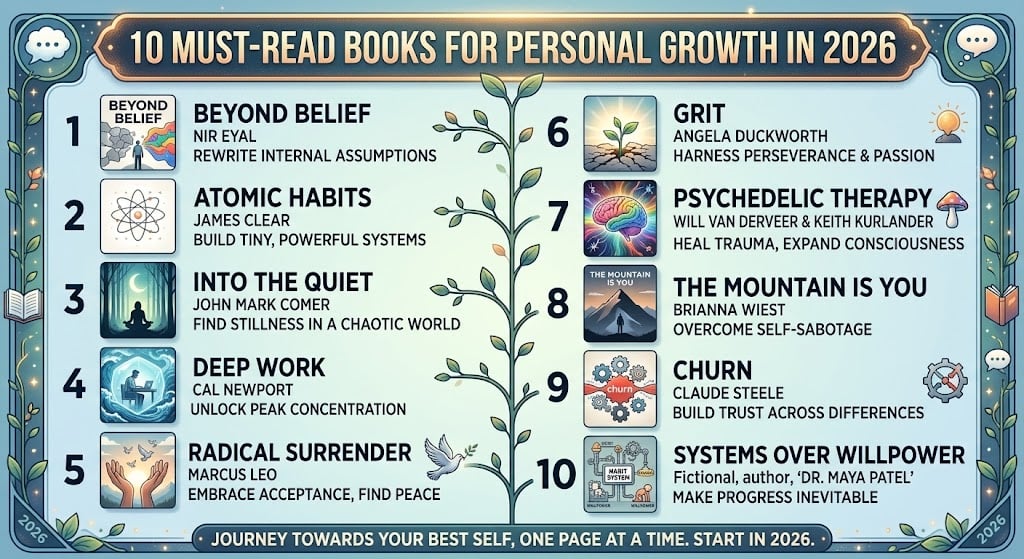
Whether you want to level up your mindset, strengthen your faith, or unlock your potential, these 10 carefully selected books will transform your 2026 and beyond.
Whether you want to level up your mindset, strengthen your faith, or unlock your potential, these 10 carefully selected books will transform your 2026 and beyond.
This article was written by Sarah Jenkins.
Personal growth is no longer simply about becoming more productive or achieving more goals. In 2026, personal development increasingly involves learning how to manage attention, build sustainable habits, understand emotions, make better decisions, communicate effectively, and create a meaningful life in an increasingly fast-moving world.
Books remain one of the most accessible ways to learn from experienced thinkers, researchers, entrepreneurs, psychologists, and writers. A good personal growth book can provide more than motivation: it can introduce a framework that changes how you approach your work, relationships, finances, habits, and long-term ambitions.
However, not every popular self-improvement book deserves a place on your reading list. Some books offer practical systems that can be applied immediately, while others are more valuable for changing the way you think. The best reading list therefore combines practical advice with psychology, philosophy, productivity, emotional intelligence, and long-term thinking.
This selection of the 10 must-read books for personal growth in 2026 focuses on books that can provide lasting value rather than temporary motivation. Each title offers a different perspective, making the list useful for readers who want to improve their habits, mindset, productivity, relationships, decision-making, or overall quality of life.
Reading is one of the simplest ways to expose yourself to ideas that you might never encounter through your normal daily routine. A book can compress years of research, experimentation, failures, and observations into a few hours of concentrated learning.
Unlike short social media posts or motivational videos, books generally give an author enough space to explain the reasoning behind an idea. This additional context matters because meaningful personal change rarely comes from a single inspirational sentence. It usually comes from understanding why a behavior exists, recognizing its consequences, and learning what to do differently.
Reading can also improve your ability to think critically. When you encounter different authors and sometimes contradictory perspectives, you are forced to evaluate ideas rather than simply accept them. This makes reading particularly valuable in an environment where people are constantly exposed to opinions, trends, productivity hacks, and simplified advice.
The goal should not be to read as many personal development books as possible. Ten books that you understand and apply can be more valuable than fifty books that you merely finish. The real benefit of reading begins when an idea moves from the page into your daily life.
Atomic Habits by James Clear is one of the most practical books for anyone who wants to understand how small behaviors can produce significant long-term results. Its central idea is straightforward: meaningful transformation does not necessarily require dramatic changes. Consistent improvements, repeated over time, can create remarkable differences.
One of the book's strongest concepts is the relationship between habits and identity. Instead of focusing exclusively on what you want to accomplish, Clear encourages readers to consider the type of person they want to become. For example, rather than saying, "I want to read twenty books this year," you can begin thinking of yourself as someone who reads regularly.
This distinction is important because goals describe an outcome, while identity influences repeated behavior. A person who sees themselves as a reader is more likely to develop routines that support reading than someone who only sets an annual reading target.
The book also introduces a useful framework for designing better habits. Making a behavior obvious, attractive, easy, and satisfying can increase the probability that you will repeat it. Conversely, making an unwanted behavior invisible, unattractive, difficult, and unsatisfying can help reduce it.
The practical value of Atomic Habits comes from its emphasis on systems. If you want to exercise more, for example, relying entirely on motivation may not work. Preparing your clothes in advance, choosing a convenient gym, scheduling a specific workout time, and reducing unnecessary friction can make the desired behavior easier to maintain.
For personal growth in 2026, this book remains particularly relevant because modern life contains countless distractions. Developing reliable systems can be more sustainable than constantly trying to force yourself to be motivated.
Stephen R. Covey's The 7 Habits of Highly Effective People is a classic of personal development that focuses on principles rather than quick productivity tricks.
The book begins with personal responsibility. One of its most important lessons is that people cannot always control external circumstances, but they can often influence how they respond to them. This shift from reacting automatically to acting deliberately can have a significant effect on both professional and personal life.
Covey also distinguishes between being busy and being effective. Someone can spend an entire day answering messages, attending meetings, checking notifications, and completing minor tasks without making meaningful progress on what truly matters.
The concept of prioritization is therefore central to the book. Important activities often require deliberate attention before they become urgent. Learning to identify those activities can help readers invest time in relationships, learning, health, professional development, and long-term objectives.
Another valuable aspect of the book is its focus on relationships. Personal effectiveness is not purely an individual matter. Communication, empathy, cooperation, and the ability to seek mutually beneficial solutions are essential skills in both professional environments and personal relationships.
Although written decades ago, the principles remain useful in 2026 because technology has changed the tools people use, but it has not fundamentally changed the need for self-discipline, responsibility, communication, and thoughtful prioritization.
Mindset by psychologist Carol S. Dweck explores how people's beliefs about ability and intelligence can influence their behavior, learning, and response to challenges.
The book is best known for distinguishing between a fixed mindset and a growth mindset. Someone with a strongly fixed view of ability may interpret failure as evidence that they are simply not good enough. Someone with a growth-oriented perspective is more likely to see difficulty as an opportunity to learn and improve.
This does not mean that effort automatically guarantees success. Personal growth requires more than simply working harder. Effective effort involves learning, adapting, receiving feedback, changing strategies, and recognizing when a particular approach is not producing results.
The concept becomes especially valuable when dealing with failure. A failed project, rejected application, disappointing exam result, or unsuccessful business experiment can become either a permanent label or a source of information.
A healthier approach is to ask better questions. What went wrong? What was under my control? What can I learn? What should I change next time?
This approach can transform setbacks into feedback.
Mindset is particularly relevant for students, entrepreneurs, professionals, athletes, and anyone entering a new field where mistakes are unavoidable. Personal growth often requires becoming comfortable with being temporarily bad at something while learning how to become better.
The Power of Now takes a different approach from books focused primarily on productivity and achievement. Instead of asking how readers can accomplish more, it explores how they can become more present and less dominated by constant mental activity.
Many people spend substantial portions of their lives thinking about the past or anticipating the future. Reflection can be useful, and planning is essential, but excessive mental preoccupation can make it difficult to experience the present moment.
The book encourages readers to observe their thoughts rather than automatically identifying with every thought they experience. This can create psychological distance between a person and their internal dialogue.
For example, instead of treating every anxious thought as an objective fact, you can recognize it as a thought occurring in your mind. That small distinction can change how you respond.
The book is more philosophical and contemplative than some of the other titles on this list. Readers looking for a step-by-step productivity system may therefore find it different from what they expect.
Its value lies in encouraging a different definition of personal growth. Growth is not always about acquiring more skills, earning more money, or reaching another milestone. Sometimes it involves learning how to experience the present with greater awareness.
Modern technology has made communication faster, but it has also made uninterrupted concentration increasingly difficult.
In Deep Work, Cal Newport examines the importance of focused work and argues that the ability to concentrate without distraction is becoming increasingly valuable.
A typical workday can be fragmented by email notifications, instant messages, meetings, social media, phone calls, and constantly changing priorities. Even when each interruption seems small, repeatedly switching between tasks can make demanding work considerably more difficult.
Deep work refers to periods of intense concentration devoted to cognitively demanding activities. This might include writing, programming, studying, designing, researching, analyzing data, or solving complex problems.
The practical lesson is not necessarily to eliminate technology. Instead, it is to use technology intentionally.
A person might create specific periods during the day for concentrated work, disable unnecessary notifications, keep their phone away during important tasks, and reserve separate periods for communication.
This approach can be particularly valuable in 2026 because artificial intelligence and automation are changing the nature of knowledge work. When routine tasks become easier to automate, uniquely human abilities such as complex reasoning, creativity, judgment, synthesis, and sustained concentration can become even more important.
Man's Search for Meaning is fundamentally different from conventional productivity books. Written by psychiatrist Viktor E. Frankl, it combines reflections on extreme human suffering with ideas associated with his psychological approach, known as logotherapy.
The book explores the importance of meaning in human life. Frankl's experiences led him to consider how people respond to circumstances that they cannot fully control.
Its message is not that suffering is inherently good or that people should simply accept difficult situations. Rather, it explores the role that meaning, responsibility, values, and perspective can play when circumstances become extremely challenging.
For readers interested in personal growth, the book offers a deeper question: What makes your life worth living?
That question can lead to very different answers. For one person, it may involve family. For another, meaningful work, creativity, service, learning, spirituality, or contributing to a community may provide a sense of purpose.
The book can therefore help readers move beyond the endless pursuit of external achievements. Success without meaning can eventually become empty, while a meaningful direction can provide motivation during difficult periods.
It is a serious book dealing with painful historical experiences, so it should not be approached as a light motivational read. Its value comes from its philosophical and psychological depth.
One of the biggest challenges in modern life is not a lack of opportunities but an excess of them.
Essentialism by Greg McKeown explores the discipline of identifying what genuinely matters and deliberately eliminating what does not.
Many people attempt to say yes to everything. They accept every invitation, respond immediately to every message, pursue too many projects, and accumulate commitments until their attention becomes fragmented.
Essentialism proposes a different philosophy: do fewer things, but do the right things better.
This does not mean becoming lazy or avoiding responsibility. It means recognizing that time and attention are limited resources.
Imagine having ten potentially valuable projects. If you divide your attention equally among all ten, you may make mediocre progress on each. If you identify the two or three that matter most, you can potentially invest significantly more energy in them.
The concept also applies outside work. Relationships, hobbies, health, learning, and personal commitments all compete for limited attention.
Learning to say "no" respectfully is therefore an important part of personal growth.
In 2026, when people are surrounded by endless digital content and opportunities, the ability to distinguish between important and merely interesting can be a major advantage.
Personal growth is not limited to habits and mindset. Financial behavior also plays an important role in the quality of life.
The Psychology of Money by Morgan Housel explores the emotional and behavioral dimensions of money. Rather than presenting personal finance as a purely mathematical subject, the book examines how personal experiences, expectations, fear, ambition, social comparison, and individual circumstances influence financial decisions.
One of its most valuable lessons is that financial behavior cannot be understood solely through numbers. Two people can have similar incomes but make radically different decisions because they have different experiences and definitions of security.
The book also encourages readers to think about the relationship between wealth and freedom. Accumulating money is not necessarily about displaying status. Financial resources can provide flexibility, resilience, and the ability to make choices with less pressure.
Another useful idea is the importance of long-term thinking. Financial outcomes often depend heavily on behavior sustained over many years rather than spectacular decisions made overnight.
Readers should not treat the book as individualized financial advice. Instead, its strength is in encouraging better questions about spending, saving, risk, lifestyle inflation, and long-term financial independence.
For anyone pursuing personal growth, understanding money can be as important as understanding productivity.
Robert Greene's The 48 Laws of Power is one of the more controversial books on this list. It examines historical examples of power, influence, strategy, and human behavior.
The book is not a conventional self-improvement manual, and readers should not necessarily interpret every principle as an instruction to manipulate other people.
Its greatest potential value can instead come from developing awareness of social dynamics.
Professional environments, organizations, business relationships, and even social groups contain informal structures of influence. Understanding reputation, incentives, communication, status, and political behavior can help people recognize dynamics that might otherwise remain invisible.
The book also raises important ethical questions. Understanding manipulation does not mean that you should manipulate others. Recognizing a tactic can simply help you identify it when someone else uses it.
This distinction is particularly important when reading books about power. Personal growth should ideally involve greater awareness without sacrificing integrity.
For that reason, The 48 Laws Of Power is best approached critically. Readers can examine the historical examples, consider whether the principles remain applicable, and decide where strategic awareness ends and unethical behavior begins.
Paulo Coelho's The Alchemist offers a more literary approach to personal growth.
The story follows Santiago, a young shepherd who embarks on a journey in pursuit of a dream. Along the way, he encounters different people and experiences that influence his understanding of purpose, courage, opportunity, failure, and personal destiny.
Unlike a traditional self-help book, The Alchemist communicates many of its ideas through fiction and symbolism.
This makes it particularly accessible to readers who do not enjoy books filled with frameworks, lists, and productivity systems.
One of its central themes is the importance of pursuing a meaningful personal path rather than simply following expectations imposed by others.
The story also emphasizes the importance of the journey itself. A goal may provide direction, but the experiences gained while pursuing that goal can become just as valuable as the final outcome.
For personal growth, this perspective is useful because people sometimes become so focused on reaching the next milestone that they overlook what they are learning along the way.
You do not need to read all ten books immediately. The best starting point depends on the area of your life you want to improve.
If your biggest challenge is consistency, Atomic Habits is an excellent starting point. It focuses on building systems and changing everyday behavior.
If you struggle with priorities and time management, The 7 Habits of Highly Effective People, Deep Work, or Essentialism may be more useful.
If you frequently become discouraged by failure, Mindset can provide a useful framework for thinking about learning and improvement.
If you feel constantly distracted or mentally overwhelmed, The Power of Now offers a more reflective approach to awareness and presence.
If you are searching for deeper purpose, Man's Search for Meaning and The Alchemist approach personal growth from philosophical and literary perspectives.
For readers who want to improve their relationship with money, The Psychology of Money is a natural choice.
Finally, readers interested in social dynamics and influence may find The 48 Laws of Power thought-provoking, provided they approach it critically and ethically.
Reading a personal development book from beginning to end is not enough to guarantee change.
A better approach is to read actively. When you encounter an idea that seems useful, stop and ask how it applies to your own situation.
Instead of highlighting dozens of sentences, identify a small number of principles that you genuinely want to remember.
It can also be useful to keep a simple reading journal. After each chapter, write down three things: the most important idea, how it relates to your life, and one action you can take.
The action is particularly important.
For example, after reading about habit formation, you could decide to put your phone outside the bedroom before going to sleep. After reading about deep work, you could schedule one uninterrupted 60-minute work session. After reading about essentialism, you could identify one unnecessary commitment to eliminate.
The purpose of reading is not to accumulate highlighted pages. It is to change decisions and behaviors.
One common mistake among personal development enthusiasts is trying to implement every idea immediately.
Someone reads about morning routines and changes their wake-up time. Then they discover meditation and add twenty minutes of meditation. Next, they read about exercise, journaling, deep work, cold showers, digital minimalism, and reading goals.
Within a few weeks, the new routine becomes exhausting.
A more sustainable strategy is to choose one meaningful change at a time.
If you read Atomic Habits, focus on one habit. If you read Deep Work, experiment with one focused work block. If you read Essentialism, identify one unnecessary obligation.
Once a behavior becomes relatively stable, introduce another improvement.
Personal growth is usually more successful when it is treated as a long-term process rather than a 30-day transformation challenge.
A powerful book can change how you see the world, but reading alone cannot produce the results you want.
You can read about exercise without becoming fitter. You can read about financial discipline without changing your spending. You can read about productivity without focusing better. You can read about communication without becoming a better listener.
Knowledge becomes valuable when it influences behavior.
This is why the most important question after finishing a personal growth book is not "What did I learn?"
A better question is:
"What will I do differently because I read this?"
Even one practical change can make a book worthwhile.
For readers who want to go through all ten books, the order can make a difference.
Starting with Atomic Habits can help establish a practical foundation for consistent behavior. Mindset can then provide a framework for approaching learning and challenges.
The 7 Habits of Highly Effective People can broaden the discussion toward responsibility, priorities, and relationships, while Deep Work focuses specifically on concentration and professional effectiveness.
After that, Essentialism can help readers decide which activities deserve their attention.
The Psychology of Money introduces an important dimension of personal development that is frequently overlooked, while The Power of Now provides a more reflective perspective.
The Alchemist can offer a lighter literary exploration of purpose and personal ambition, followed by the more serious reflections found in Man's Search for Meaning.
Finally, The 48 Laws of Power can be read as a critical exploration of influence and social dynamics.
The order is not mandatory. The best sequence is the one that matches your current needs.
You could structure your 2026 reading journey around one book per month rather than trying to consume everything quickly.
During the first month, select a book that addresses your biggest current challenge. Read consistently and implement one idea.
During the second month, choose a book that complements the first. If the first book focused on habits, the second could focus on mindset or concentration.
Continue this process throughout the year.
You can also reserve the final two months for reviewing your notes rather than simply adding more books. Revisit the ideas that had the greatest impact and determine which changes actually lasted.
This approach turns reading into an annual development project rather than a collection of unfinished books.
Motivation can be useful, but it is temporary.
A motivational video can make you feel ready to change. A powerful quote can inspire you for an afternoon. A successful person's story can encourage you to take action.
But lasting growth requires systems, reflection, repetition, and adaptation.
The books on this list represent different parts of that process. Atomic Habits focuses on behavior. Mindset examines beliefs about learning. Deep Work addresses concentration. Essentialism addresses priorities. The Psychology of Money explores financial behavior. Man's Search for Meaning examines purpose.
Together, they demonstrate that personal growth is multidimensional.
You do not need to become a completely different person overnight. The objective is to gradually become more intentional about how you use your time, attention, energy, money, relationships, and abilities.
One of the most effective ways to use self-improvement books is to treat their recommendations as experiments rather than absolute rules.
Suppose a book recommends waking up early. Instead of assuming that early mornings are universally superior, test the idea for two weeks and observe whether it actually improves your productivity and well-being.
The same principle applies to digital detoxes, journaling, time blocking, meditation, reading routines, or productivity systems.
Ask yourself what changes.
Do you concentrate better? Do you sleep better? Are you less stressed? Are you accomplishing more meaningful work? Are your relationships improving?
This experimental approach prevents personal development from becoming another source of pressure.
A strategy is useful when it improves your life, not simply because a famous author recommends it.
The personal development industry changes constantly. New books appear every year promising greater productivity, success, wealth, confidence, and happiness.
However, timeless ideas can remain useful even when technology changes.
A valuable personal growth book should ideally do at least one of three things: help you understand yourself better, provide a practical framework for making better decisions, or challenge assumptions that limit your behavior.
The strongest books also encourage independent thinking rather than asking readers to blindly follow a formula.
This is especially important in 2026. Artificial intelligence can provide information instantly, social media can deliver thousands of opinions per day, and productivity tools can automate many routine activities. In such an environment, knowing what deserves your attention may be more important than simply having access to more information.
The 10 must-read books for personal growth in 2026 offer very different perspectives, but they share an important principle: meaningful improvement takes time.
Atomic Habits teaches the power of small behavioral changes. The 7 Habits of Highly Effective People emphasizes principles, responsibility, priorities, and relationships. Mindset explores how beliefs influence learning. The Power of Now encourages greater presence. Deep Work highlights the value of concentration. Man's Search for Meaning examines purpose and resilience. Essentialism teaches the importance of focusing on what matters. The Psychology of Money explores financial behavior. The 48 Laws of Power examines influence and social dynamics. The Alchemist offers a literary reflection on dreams, purpose, and personal journeys.
You do not need to agree with every idea in these books. In fact, critical reading is part of personal growth.
Choose the books that address your current challenges. Read slowly enough to understand the ideas. Take notes. Question the arguments. Experiment with the recommendations. Keep what works and discard what does not.
Ultimately, the goal of reading is not to become someone who has read hundreds of self-improvement books.
The goal is to become someone who thinks more clearly, chooses more intentionally, learns from experience, and lives according to values that genuinely matter.
In that sense, one well-read and well-applied book can be more transformative than an entire shelf of books that were never put into practice.
A personal-growth reading list should not encourage readers to consume books endlessly without applying anything. In our view, ten carefully selected books are more valuable when they represent different dimensions of personal development: habits, emotional intelligence, relationships, financial literacy, resilience and self-awareness.
We also recommend avoiding the idea that a new year automatically requires a completely new version of yourself. Sustainable personal development is usually incremental. A reader does not need to transform every aspect of life simultaneously.
The best way to use this list is therefore to choose one book according to the problem or goal that currently matters most. After finishing it, the reader should identify one or two ideas worth implementing. The value of a personal-growth book ultimately appears in behavior, not in the number of pages read.
Be the first to comment!