
Quick Summary (TL;DR)
Introduction
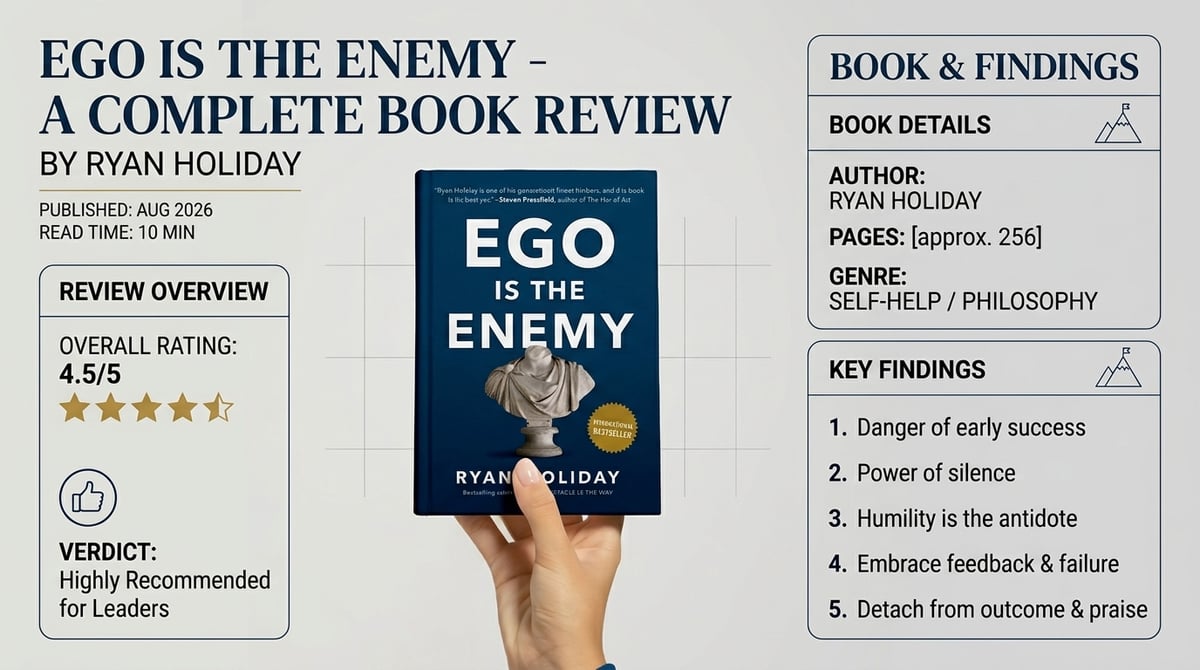
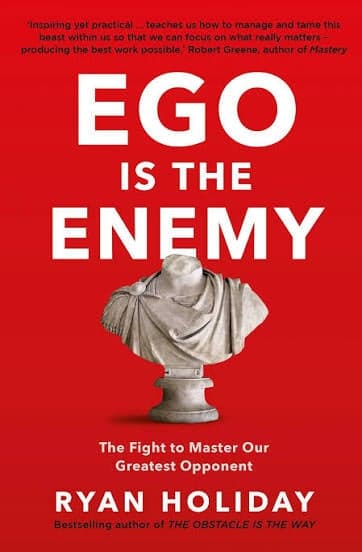
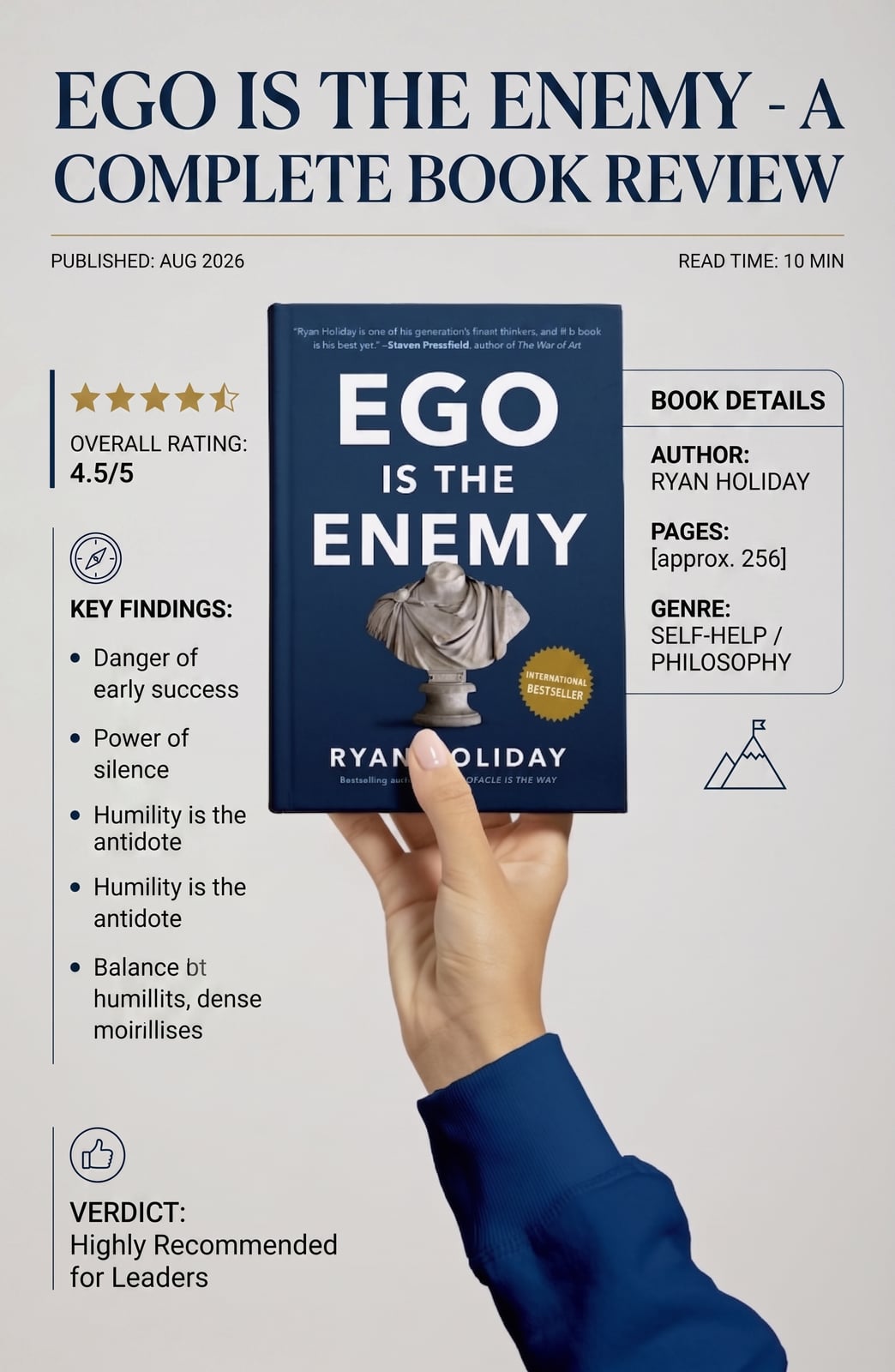
Published in 2016, Ego Is the Enemy is Ryan Holiday's meditation on one of the most destructive forces in human life: the ego. Not ego in the colloquial sense of confidence or self-belief, but ego in its most dangerous form — the irrational and inflated sense of one's own importance, the voice that whispers that we are already great before we have done the work, and that convinces us to protect our image rather than pursue our purpose.
Holiday structures the book around three phases of life that everyone experiences: Aspire (when we are striving for something), Success (when we have achieved it), and Failure (when we have lost it or fallen short). He argues that ego is the enemy at every stage — it prevents us from learning when we are rising, from sustaining our success when we arrive, and from recovering when we fall.
Drawing on the lives of historical figures including William Tecumseh Sherman, Howard Hughes, Katharine Graham, and Angela Davis, Holiday builds a compelling case that the most enduring achievers across history shared one crucial trait: the ability to suppress their ego, stay humble, keep learning, and let their work speak for itself.
This book is not a comfortable read. It holds up a mirror to the reader and asks a challenging question: is ego standing between you and the person you could become?
About the Author: Ryan Holiday
Ryan Holiday is one of the most influential writers working at the intersection of Stoic philosophy and modern life. Born in 1987, he dropped out of college at 19 to apprentice under Robert Greene, author of The 48 Laws of Power, before becoming the Director of Marketing at American Apparel at just 21 years old.
Holiday is known for applying ancient Stoic wisdom — the philosophy of Marcus Aurelius, Epictetus, and Seneca — to the challenges of modern ambition, leadership, and resilience. His Obstacle Is the Way trilogy (The Obstacle Is the Way, Ego Is the Enemy, and Stillness Is the Key) has sold millions of copies and been read by athletes, generals, CEOs, and artists around the world.
Holiday is also the founder of the Daily Stoic, one of the most popular philosophy newsletters and social media channels in the world, and has authored over a dozen books. He lives in Texas, where he runs a bookstore and small farm.
Ego Is the Enemy, published in 2016, draws on his experience working inside some of the most ego-driven environments in media and business, as well as years of Stoic study, to produce what many consider his most personally resonant work.
The Three Phases: Aspire, Success, Failure
Holiday structures Ego Is the Enemy around three universal phases that every person passes through repeatedly throughout their life:
Part I — Aspire: This section addresses the ego's role during the pursuit of our goals. Holiday warns that talking about what we plan to do, crafting an elaborate identity around our ambitions, and seeking validation before the work is done are all ways ego sabotages us before we even begin. His advice: be a student, not a performer. Do the work in silence. Let results speak.
Key figures in this section include General William Sherman, who spent years in obscurity and self-doubt before the Civil War, always learning and preparing rather than self-promoting, and Eleanor Roosevelt, who overcame a painful, ego-crushing childhood to become one of the great leaders of the 20th century.
Part II — Success: This section explores how success is often more dangerous than failure for the ego. Once we achieve what we wanted, the ego whispers that we are now special, that the rules no longer apply to us, that we deserve recognition and comfort. Holiday illustrates how this mindset has destroyed countless careers and companies.
Part III — Failure: Perhaps the most powerful section, this part examines how ego makes failure catastrophic rather than instructive. When our identity is built on success and image, failure feels like annihilation. But those who separate their self-worth from their results can use failure as data, learn from it, and rebuild stronger. Holiday uses the example of Katharine Graham, who took over the Washington Post after her husband's death with no business experience, conquered her fear and ego, and turned the paper into one of the most respected institutions in American journalism.
Key Themes: Humility, Discipline, and Doing the Work
Throughout all three phases, Ego Is the Enemy returns to a set of interconnected themes that define its philosophy:
Talk Less, Do More: One of Holiday's most repeated arguments is that the modern culture of self-promotion and personal branding encourages us to perform success before we have achieved it. Social media, in particular, rewards the illusion of accomplishment. Every hour spent crafting your image is an hour not spent developing the skills that make the image deserved.
The Canvas Strategy: Holiday introduces the idea of being someone who creates opportunities for others, who smooths the path for those above them rather than seeking recognition. This deliberate humility — making others look good, doing the unglamorous work, refusing to compete for credit — is how great careers are quietly built.
Be a Student Forever: The moment we think we know enough is the moment we stop growing. Holiday argues that the most dangerous consequence of early success is believing that you have already figured it out. The greatest achievers maintain a beginner's mindset long after they have mastered their craft.
Purpose Over Passion: Holiday challenges the popular idea of "following your passion," arguing that passion without discipline, craft, and humility is just another form of ego. True purpose is quieter, more durable, and more powerful than the burning excitement we call passion.
Identity and Results: The ego confuses who we are with what we have achieved. When success becomes our identity, any threat to our success becomes a threat to our self. Holiday argues for separating identity from outcome as the key to psychological resilience and long-term performance.
Writing Style: Philosophical, Story-Driven, and Confrontational
Ryan Holiday writes with the authority of someone who has studied Stoicism deeply and lived in environments where ego ran unchecked. His prose is measured, precise, and deliberately unsentimental. He does not coddle the reader. He names the problem — your ego — and then spends the entire book showing you how it is working against you.
The book's greatest stylistic strength is its use of historical narrative. Holiday is a voracious reader and researcher, and each chapter is grounded in real stories drawn from history, biography, and his own experience. Rather than telling readers what to think, he shows them how the principles played out in the lives of generals, politicians, artists, and CEOs. This approach makes abstract philosophy tangible and viscerally relevant.
The chapters are short and punchy, making the book highly readable despite the density of its ideas. Holiday writes in a way that rewards re-reading — passages that feel obvious on a first read often reveal deeper layers of meaning when you encounter them again after life experience.
Some readers may find the book harsh or even discouraging. Holiday is not interested in making you feel good. He is interested in making you better. For readers who approach it honestly and are willing to see themselves reflected in its descriptions of ego-driven behavior, the book can be genuinely transformative.
Who Should Read This Book?
Ego Is the Enemy is for anyone who is serious about long-term achievement and honest enough to confront the ways they may be standing in their own way. It is not a book for people looking for validation or motivation — it is a book for people who want to grow.
This book is particularly valuable for:
-
Young professionals and entrepreneurs at the beginning of their careers, who are building ambitions and identities and need the humility to learn before they lead.
-
People who have recently achieved significant success and want to ensure that success does not corrupt their judgment, work ethic, or relationships.
-
Anyone who has experienced a major failure and is struggling to understand it, process it, and rebuild from it with wisdom rather than bitterness.
-
Leaders and managers who want to create cultures of honesty, accountability, and continuous learning rather than ego-protection and political maneuvering.
-
Readers of Ryan Holiday's other Stoic trilogy books (The Obstacle Is the Way, Stillness Is the Key) who want to deepen their engagement with his philosophy.
-
Anyone who has ever caught themselves more concerned with how they appear than with what they are actually producing.
Final Verdict: Is Ego Is the Enemy Worth Reading?
Ego Is the Enemy is one of the most honest and necessary books available for anyone who is serious about building a meaningful life and career. In a culture that glorifies self-promotion, personal branding, and the performance of success, Holiday's book is a vital corrective.
It does not promise to make you feel good. It promises to make you honest with yourself, which is a far greater gift. By naming the ego clearly and showing exactly how it operates at every stage of life, Holiday gives readers the tools to recognize it in themselves and choose differently.
The book is grounded in history, philosophy, and hard-won personal experience. Its lessons are timeless. Whether you are at the start of your career, at the peak of your success, or in the middle of a painful failure, Ego Is the Enemy has something essential to say to you.
Rating: 5 / 5
Ego Is the Enemy is essential reading for anyone who wants to achieve great things and stay grounded enough to sustain them. It is the kind of book you read once and carry with you for the rest of your life.
Our Critical Perspective
The central idea of Ego Is the Enemy is particularly interesting because ego does not appear only after success. Ryan Holiday argues that it can interfere with us when we are beginning something, when we are achieving success and even when we are dealing with failure.
We find this perspective useful because beginners can sometimes become more concerned with recognition than with learning. Successful people may become attached to their reputation, while people who fail may allow the experience to define their identity. In each situation, ego can interfere with objective judgment.
However, we would not interpret the book as an argument for eliminating confidence or ambition. Those qualities can be essential for taking risks and pursuing difficult goals. The more useful lesson is learning how to prevent self-image from becoming more important than reality.
Our overall assessment is that Ryan Holiday's book works particularly well as a reminder to remain curious, accept criticism and continue learning even after achieving recognition. Its strongest message is not that ambition is dangerous, but that ambition becomes destructive when protecting one's ego becomes more important than improving.