riwaya.
We use cookies to improve your experience, analyze our traffic, and offer you personalized offers. Learn more in our Privacy Policy.
جيمس كلير
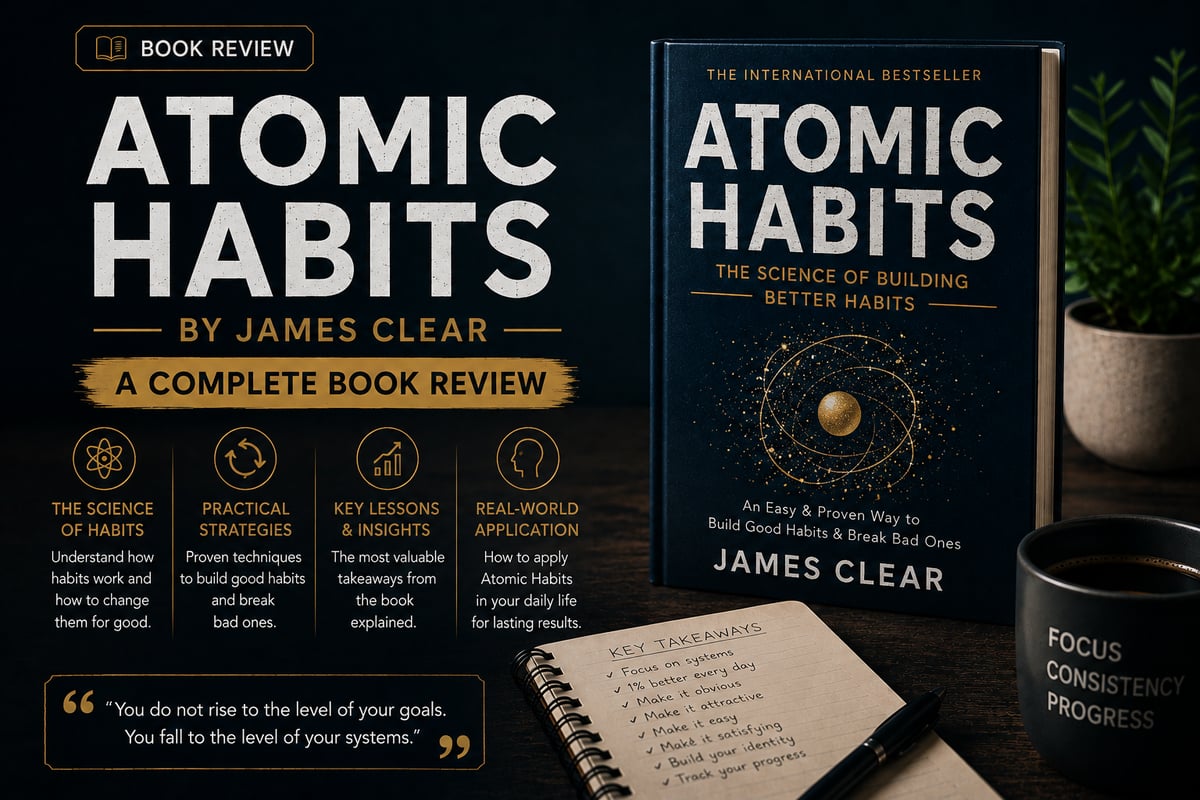
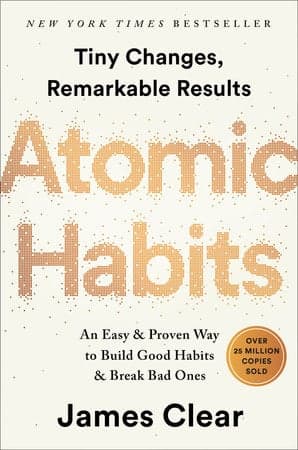
Atomic Habits by James Clear is one of the most practical and insightful books ever written on the science of habit formation. With over 15 million copies sold…
Atomic Habits by James Clear is one of the most practical and insightful books ever written on the science of habit formation. With over 15 million copies sold…
This article was written by Sarah Jenkins.
In a world obsessed with dramatic transformations and overnight success, Atomic Habits offers a refreshingly different approach: the power of tiny changes. Published in 2018 by James Clear, this book has become one of the defining self-help texts of the modern era, selling over 15 million copies and being translated into more than 50 languages.
The central thesis is elegantly simple — if you get just 1% better every day, the results over time are extraordinary. Clear argues that success is not the product of massive actions, but the result of consistent, compounding habits that accumulate silently in the background of our lives.
This review will walk you through the book's key ideas, its author's background, the core framework it presents, and why it remains one of the most recommended books for anyone serious about personal growth and lasting change.
James Clear is an American author, speaker, and entrepreneur who has dedicated his career to studying the intersection of habits, decision-making, and continuous improvement. Born in 1986, Clear began writing about habits and performance on his website jamesclear.com, where he quickly built one of the largest audiences in the self-improvement space.
Before writing Atomic Habits, Clear experienced a serious injury in high school — he was hit in the face by a baseball bat — which left him temporarily blind and forced him to rebuild his life from the ground up. This experience taught him firsthand about the power of small, consistent progress during recovery, which later became the foundation of his philosophy.
His newsletter attracts millions of subscribers, and he has spoken at organizations ranging from the NFL to Fortune 500 companies. Atomic Habits, his first major book, was published in October 2018 and became an instant bestseller, cementing Clear's position as one of the most influential voices in behavioral science and self-development.
The foundation of Atomic Habits rests on a deceptively simple mathematical insight: if you improve by just 1% each day for a year, you end up 37 times better than when you started. Conversely, if you get 1% worse each day, you decline nearly to zero. This is the magic of compounding applied not to money, but to personal behavior.
Clear introduces what he calls the Four Laws of Behavior Change, a framework for building good habits and breaking bad ones:
To break bad habits, Clear advises inverting each law: make it invisible, unattractive, difficult, and unsatisfying.
Another powerful concept in the book is the idea of identity-based habits. Instead of focusing on goals ("I want to run a marathon"), Clear argues you should focus on identity ("I am a runner"). Every time you act in alignment with your desired identity, you cast a vote for that version of yourself. Over time, habits become a reflection of who you believe you are.
Atomic Habits is rich with actionable strategies that readers can implement immediately. Here are some of the most memorable and useful concepts:
Habit Stacking: Clear introduces the idea of linking a new habit to an existing one. For example: "After I pour my morning coffee, I will meditate for two minutes." This uses existing behavioral cues to anchor new behaviors.
The Two-Minute Rule: Any new habit should be scaled down to take two minutes or less to start. Want to read more? Start by opening a book and reading one page. The goal is to show up consistently, not to perform perfectly.
Environment Design: Clear emphasizes that motivation is overrated and environment matters more. If you want to eat healthier, put fruit on the counter instead of in the fridge. If you want to practice guitar, leave it on the stand in the living room. Your surroundings shape your behavior more than willpower does.
The Habit Loop: Building on Charles Duhigg's work, Clear describes habits as a four-step loop: Cue, Craving, Response, Reward. Understanding this loop helps you diagnose existing habits and design new ones.
Tracking and Measurement: Never miss twice. Missing a habit once is an accident. Missing it twice is the start of a new habit. Clear advocates for habit tracking as a way to maintain streaks and build momentum.
One of the great strengths of Atomic Habits is how James Clear writes. He strikes a rare balance between scientific rigor and practical accessibility. Every major claim in the book is backed by research from psychology, neuroscience, and behavioral economics — yet the prose never feels academic or dry.
Clear makes heavy use of compelling stories. From British cycling coach Dave Brailsford's famous "aggregation of marginal gains" to the tale of how Ronan Byrne turned exercise into a habit by combining it with Netflix, each chapter opens with a narrative that draws readers in before delivering the key lesson.
The book is also visually well-organized. Clear uses bullet points, bold text, chapter summaries called "Little Lessons from the Four Laws," and simple diagrams to reinforce key concepts. It is the kind of book you can read cover to cover or return to for reference on specific topics.
Some critics argue the book oversimplifies human behavior and ignores deeper psychological or structural barriers to change. While this is a fair critique, for the vast majority of readers, the clarity and actionability of Clear's writing is a feature, not a bug.
Atomic Habits is an exceptionally versatile book that benefits a wide range of readers:
Anyone who has ever struggled to stick with a new habit, whether it is exercising, reading, meditating, eating well, or any other positive behavior. The book offers a concrete, tested system for overcoming the obstacles that cause most people to quit.
Professionals and entrepreneurs who want to improve their productivity and performance. The principles translate directly to work routines, time management, and building discipline in any field.
Students and young adults who are building the foundations of their daily routines. The earlier these principles are learned, the greater their long-term compounding effect.
Parents and educators who want to teach the next generation about the mechanics of behavior, motivation, and sustainable self-improvement.
Anyone who has read other self-help books but found the advice too abstract or vague. Atomic Habits is known for being deeply practical and immediately actionable.
Even if you have already read similar books like The Power of Habit by Charles Duhigg or Thinking, Fast and Slow by Daniel Kahneman, Atomic Habits offers a fresh, more practical perspective that complements and extends those ideas.
Atomic Habits is, without question, one of the best self-help books of the past decade. It succeeds where most books in this genre fail: it gives you a concrete, practical system that you can actually use, not just an inspiring story or a vague set of principles.
James Clear has synthesized decades of scientific research into a readable, relatable, and immediately applicable guide to behavioral change. Whether you want to build better health habits, improve at work, strengthen relationships, or simply become more consistent in your daily life, this book provides the tools to do it.
The book's greatest insight — that identity is the foundation of lasting habit change — is not just motivating but genuinely transformative for how you understand yourself and what you are capable of becoming.
Rating: 5 / 5
If you read only one self-improvement book this year, make it Atomic Habits. Its lessons are timeless, its system is proven, and its impact on your daily life will compound far beyond what you can currently imagine.
The strongest aspect of Atomic Habits is its practical approach to behavior change. James Clear moves the discussion away from the simplistic idea that people simply need more willpower and instead examines how environment, repetition and small behavioral cues influence what we do every day.
We particularly appreciate the emphasis on systems. A person who wants to read more, exercise regularly or learn a new skill can make the desired behavior easier by changing the environment around them. This is often more realistic than depending entirely on motivation.
At the same time, the framework should not be treated as a universal explanation for every personal difficulty. Not every obstacle is caused by poor habits, and external circumstances can have a major influence on what people are able to accomplish.
Our conclusion is that Atomic Habits is most valuable as a practical starting point. Its ideas become meaningful when they are tested in real life and adapted to individual circumstances. Reading the book is only the first step; the real value appears when one or two ideas are transformed into sustainable behaviors.
Be the first to comment!