riwaya.
We use cookies to improve your experience, analyze our traffic, and offer you personalized offers. Learn more in our Privacy Policy.
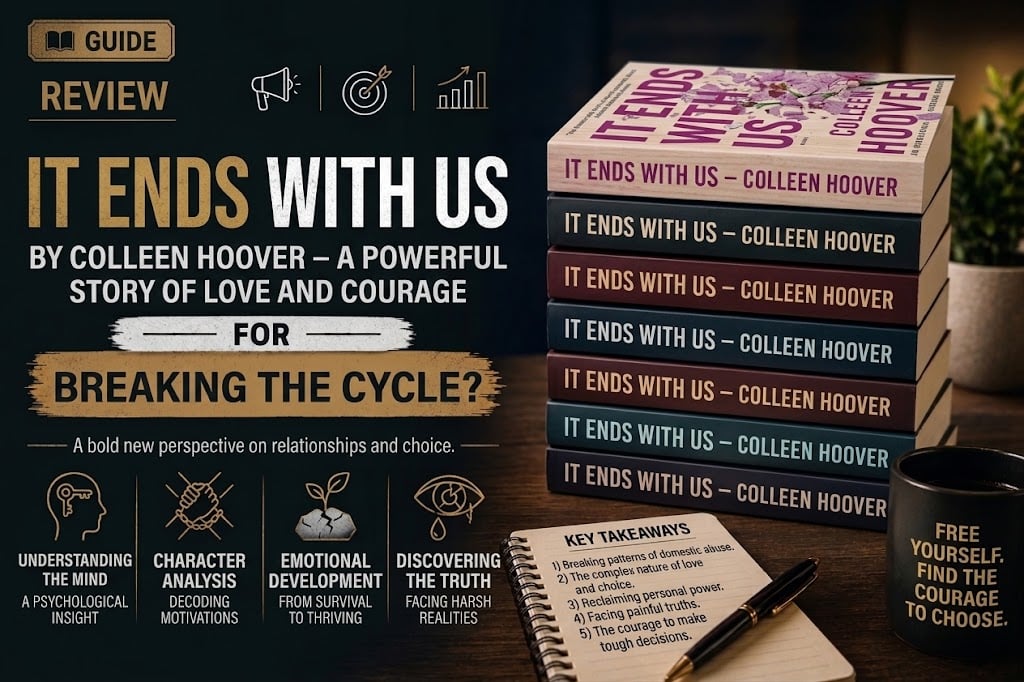
It Ends with Us is a deeply emotional novel by Colleen Hoover that explores the complexities of love, strength, and the courage it takes to walk away from what hurts you.
It Ends with Us is a deeply emotional novel by Colleen Hoover that explores the complexities of love, strength, and the courage it takes to walk away from what hurts you.
This article was written by Sarah Jenkins.
It Ends With Us by Colleen Hoover is a contemporary romance novel that goes far beyond the conventions of a traditional love story. Published in 2016, the book follows Lily Bloom as she builds a new life in Boston, develops a complicated relationship with Ryle Kincaid, and is forced to confront painful experiences from both her past and present.
At first glance, the novel contains many familiar elements of contemporary romance: attraction, complicated relationships, emotional vulnerability, and a connection with a person from the past. However, beneath that framework, Hoover explores much more difficult questions about domestic abuse, emotional dependence, family history, boundaries, forgiveness, and personal courage.
The novel's emotional impact comes from the fact that its central conflict is not presented as a simple battle between a good person and an obviously bad person. Instead, Lily finds herself in a deeply complicated situation in which affection, attraction, fear, disappointment, and hope can exist at the same time.
That complexity is what makes the book particularly memorable.
It Ends With Us asks an uncomfortable but important question: What happens when the person you love becomes the person who hurts you?
Colleen Hoover is an American author known for contemporary romance and emotionally driven fiction. Her books often combine romantic relationships with themes involving family, trauma, identity, grief, difficult choices, and personal transformation.
Her writing has attracted a particularly large readership among younger audiences, and social media platforms such as TikTok have played a major role in introducing her novels to new generations of readers.
What distinguishes Hoover's approach is her willingness to place emotionally difficult subjects inside accessible relationship-driven stories. Instead of presenting characters as perfectly rational people, she often focuses on the contradictions that exist within real emotional experiences.
That approach is particularly important in It Ends With Us, where the protagonist's decisions cannot be understood simply by asking whether she knows something is wrong.
The more difficult question is why leaving can be so complicated even when someone recognizes that a relationship is harmful.
The novel follows Lily Bloom, a young woman who moves to Boston after the death of her father.
The move represents more than a change of location. Lily wants to create a life that belongs to her, separate from the difficult memories associated with her childhood.
She eventually meets Ryle Kincaid, a successful neurosurgeon whose confidence and ambition immediately attract her.
Their relationship develops quickly, and Lily becomes increasingly emotionally invested in him.
However, the relationship gradually becomes more complicated than she initially expected.
At the same time, Lily's past begins returning to her life through Atlas Corrigan, someone with whom she shared an important relationship during her teenage years.
The story therefore moves between Lily's present circumstances and memories of her earlier life, allowing readers to understand how her past influences the decisions she makes in the present.
Lily is compelling because she is not written as someone who has everything figured out.
She has ambitions.
She has fears.
She makes mistakes.
She loves deeply.
She sometimes struggles to understand her own emotions.
Most importantly, she has to make decisions in circumstances where there is no simple emotional solution.
Her character development is therefore not about becoming a completely different person.
It is about learning to trust her own perspective and recognize what she deserves from a relationship.
This makes her journey particularly relevant to the novel's larger theme of courage.
Ryle is introduced as intelligent, successful, confident, and attractive.
These qualities make Lily's attraction to him understandable.
The novel deliberately avoids making the relationship feel obviously dangerous from the beginning.
Instead, the situation becomes progressively more complicated.
This is important because domestic abuse does not necessarily occur in relationships that look frightening from the outside.
A person can be successful, charming, educated, generous, or respected while still behaving abusively in private.
The contrast between public identity and private behavior is one of the novel's most important ideas.
Atlas represents an important part of Lily's history.
Their relationship began when they were younger, during a period when both characters were dealing with difficult circumstances.
His return to Lily's life creates another emotional layer within the story.
Atlas is not simply a conventional romantic alternative.
His presence also reminds Lily of who she was before her relationship with Ryle and reconnects her with memories she has tried to understand.
Through Atlas, the novel explores the relationship between memory and identity.
Lily's childhood is essential to understanding the novel.
As a young girl, she witnesses behavior between her parents that deeply affects her understanding of relationships.
Her experiences create an internal contradiction.
She knows that certain behavior is wrong, yet she also loves the people involved.
This distinction becomes crucial later in her life.
One of the novel's most powerful ideas is that recognizing abuse intellectually does not necessarily make it easy to respond to abuse emotionally.
The phrase cycle of abuse is central to understanding the novel.
Abusive relationships can involve repeated patterns of harmful behavior, remorse, reconciliation, tension, and renewed conflict.
The emotional complexity of such relationships can make them difficult to understand from the outside.
Someone observing a relationship may ask:
"Why doesn't she simply leave?"
The novel challenges the simplicity of that question.
Leaving a harmful relationship can involve emotional attachment, fear, financial concerns, social pressure, hope for change, and many other factors.
One of the most important contributions of the novel is its exploration of why people can remain emotionally attached to someone who hurts them.
Lily does not suddenly stop caring about Ryle.
Her feelings do not disappear simply because she experiences something harmful.
This is psychologically significant.
People can simultaneously love someone and recognize that their behavior is unacceptable.
Those two realities can exist together.
Understanding this contradiction helps explain why abusive relationships cannot always be reduced to simple questions of logic.
The novel challenges the idea that abuse automatically means there was never any genuine affection.
Lily experiences real emotions.
She has good memories.
She experiences attraction.
She hopes for a future.
These experiences do not erase the harmful behavior.
Likewise, the existence of harmful behavior does not mean every positive moment was necessarily meaningless.
This complexity can be uncomfortable, but it is one of the novel's most important insights.
One of the central lessons of It Ends With Us is that love alone is not enough to create a healthy relationship.
A healthy relationship also requires respect, safety, trust, accountability, communication, and boundaries.
Someone can love another person and still be incapable of providing a safe relationship.
That distinction is important because romantic culture sometimes presents love as something powerful enough to overcome every obstacle.
Real relationships are more complicated.
Love does not excuse harmful behavior.
Boundaries are another important theme in the novel.
A boundary is not simply a threat or punishment.
It is a clear statement about what behavior a person will accept and what they will do when that boundary is violated.
Healthy relationships require boundaries because each person remains an individual with their own emotional and physical needs.
Lily's journey involves gradually understanding that protecting herself is not selfish.
It is an essential part of self-respect.
The word "courage" is particularly appropriate when discussing Lily's story.
Courage is often portrayed as dramatic or heroic.
In reality, courage can involve making a painful decision privately.
It can mean admitting that a relationship is not healthy.
It can mean accepting that love cannot fix everything.
It can mean disappointing someone.
It can mean choosing uncertainty over a familiar but harmful situation.
Lily's courage comes from confronting a reality she desperately wishes were different.
The title It Ends With Us carries a powerful meaning.
It refers not simply to the end of a relationship but to the possibility of ending a destructive pattern.
The "us" can be understood as a generational connection.
Lily has witnessed painful behavior during her childhood.
She now faces similar dynamics in her adult life.
Her ultimate decision therefore becomes about more than herself.
It becomes about whether the cycle continues into another generation.
Generational patterns can be extremely difficult to recognize.
People often reproduce behaviors they learned early in life, sometimes without consciously realizing it.
Family environments influence beliefs about communication, conflict, affection, and acceptable behavior.
Breaking a pattern requires recognizing it first.
The novel illustrates how difficult that process can be.
Lily must confront the uncomfortable possibility that her childhood experiences have influenced the relationships she accepts as an adult.
Childhood does not determine someone's future completely.
However, early experiences can influence expectations and emotional responses.
Someone who grows up around conflict may develop a particular understanding of what relationships look like.
Someone who witnesses unhealthy behavior may struggle to recognize what healthy behavior should feel like.
This does not mean people are trapped by their past.
Rather, awareness can become the beginning of change.
At its deepest level, It Ends With Us is also a story about self-worth.
Lily must eventually confront a difficult question:
What does she believe she deserves?
Self-worth is not simply confidence or feeling good about yourself.
It also affects the standards you apply to relationships.
When someone understands that they deserve respect and safety, harmful behavior becomes harder to rationalize.
This does not make difficult decisions painless.
It makes them more possible.
Forgiveness is another complicated idea within the novel.
Forgiving someone does not necessarily mean remaining with them.
It does not mean pretending harmful behavior never happened.
It does not mean removing consequences.
Forgiveness can be understood as releasing oneself from the expectation that the past must continue determining the future.
The novel treats forgiveness as something emotionally complicated rather than a simple moral obligation.
It Ends With Us deals with subjects that can be uncomfortable for readers.
Domestic abuse, family conflict, emotional dependence, trauma, and difficult relationship decisions are not light themes.
The emotional intensity comes from the contrast between the romance elements and the increasingly serious realities Lily encounters.
Readers expecting a conventional love story may therefore be surprised by the direction of the novel.
It is better understood as contemporary fiction with strong romantic elements and a serious examination of abuse.
One reason the story has generated so much discussion is its emotional ambiguity.
Readers are encouraged to experience Lily's confusion rather than simply observe it from a distance.
That can make certain moments frustrating.
It can also make them more realistic.
People rarely experience complicated relationships as a neat sequence of obvious decisions.
Emotions overlap.
Memories conflict.
Hope competes with fear.
Logic competes with attachment.
This is part of what gives the novel its emotional force.
Fiction can help readers understand experiences that they have never personally encountered.
Someone who has never experienced an abusive relationship may not immediately understand why leaving can be complicated.
Through Lily's perspective, the reader is encouraged to consider the emotional mechanisms involved.
This does not mean fiction replaces professional education or survivor support.
Rather, literature can create an emotional starting point for empathy and discussion.
The novel can also encourage readers to reconsider what they define as a healthy relationship.
A healthy relationship should not be measured only by chemistry.
Attraction is important, but so are:
Respect.
Emotional safety.
Honesty.
Accountability.
Mutual boundaries.
Freedom from intimidation.
The ability to disagree without fear.
These qualities provide a more complete framework for understanding relationship health.
Although It Ends With Us was originally published in 2016, its popularity grew dramatically years later, particularly through social media and BookTok.
Short videos, emotional recommendations, quotations, reactions, and reader discussions introduced the book to a massive new audience.
This phenomenon demonstrates how social platforms can revive older books and transform them into cultural events.
For many younger readers, social media became their first exposure to Colleen Hoover.
BookTok has changed how books are discovered.
Instead of relying exclusively on traditional reviews, readers increasingly encounter books through personal recommendations.
An emotional reaction to a novel can encourage thousands of people to read it.
It Ends With Us became particularly suitable for this environment because it generates strong emotional responses and discussion.
Readers may finish the book wanting to discuss its characters, decisions, themes, and ending.
That conversational quality contributes to its popularity.
The book contains significant romantic elements, but labeling it simply as a romance can create misleading expectations.
At its core, the story is about Lily's emotional and personal journey.
Romance is an important component, but so are family history, abuse, identity, trauma, boundaries, and empowerment.
Readers who expect a lighthearted romantic story may therefore find the subject matter considerably heavier than anticipated.
Because the novel deals with domestic abuse and related themes, it may not be comfortable for every reader.
People who find these subjects emotionally difficult should consider the themes before deciding whether to read it.
The book's value does not depend on every reader enjoying it.
Sometimes an important book is also a difficult book.
Potential readers should be aware that the novel explores themes including domestic violence, abusive relationships, family conflict, trauma, emotional manipulation, and difficult relationship decisions.
Knowing this beforehand can help readers make an informed decision about whether the book is appropriate for them.
This is particularly important when recommending books that deal with sensitive subjects.
Lily's journey is powerful because her ultimate strength does not come from becoming emotionally invulnerable.
She remains capable of love.
She remains capable of compassion.
She remains affected by her experiences.
But she becomes more capable of making decisions based on her values rather than simply her attachment to another person.
That distinction represents a significant form of personal growth.
The novel also suggests that strength does not require becoming cold.
Lily does not need to stop caring in order to protect herself.
She can recognize complexity while still establishing limits.
This is an important distinction.
Strength can involve compassion and boundaries at the same time.
A person can understand why someone behaves a certain way without accepting the behavior.
One of the strongest lessons is that love should not require sacrificing personal safety or dignity.
Another is that people cannot always be judged solely by their most charming moments.
Actions matter.
Patterns matter.
Accountability matters.
The novel also reminds readers that recognizing a harmful pattern is not the same as being responsible for creating it.
Most importantly, it emphasizes the possibility of breaking patterns that have existed for years.
The novel avoids presenting relationships as perfectly simple.
People can be loving in some moments and harmful in others.
Someone can have positive qualities while still behaving in unacceptable ways.
Understanding this distinction is important because it prevents readers from relying on simplistic ideas about abusive relationships.
The question is not whether someone has good qualities.
The question is whether the relationship is safe and healthy.
A healthy relationship requires accountability.
When someone causes harm, meaningful change involves more than saying sorry.
It requires recognizing the behavior, accepting responsibility, understanding its impact, and demonstrating sustained change.
Without accountability, apologies can become part of a repeated cycle.
The novel encourages readers to look beyond words and consider patterns of behavior.
Choosing yourself does not necessarily mean becoming selfish.
It can mean recognizing your own dignity and refusing to accept circumstances that fundamentally violate your values.
Lily's journey demonstrates that self-preservation can require painful decisions.
Sometimes the hardest decision is also the one that creates the possibility of a healthier future.
The conclusion of the novel gives greater meaning to its title and central theme.
Without revealing the most important details, the ending shifts attention away from romantic fantasy and toward responsibility, protection, and the possibility of breaking harmful patterns.
The emotional impact comes from understanding that certain choices affect more than the person making them.
They can influence future generations.
The novel stays with readers because it does not ask only whether Lily loves someone.
It asks whether love is enough.
It asks what happens when affection conflicts with safety.
It asks whether people can change.
It asks whether forgiveness requires reconciliation.
And it asks how much courage is required to stop a cycle that has existed before you.
These questions extend beyond the fictional story.
They are questions about relationships, identity, family, and personal boundaries.
It Ends With Us by Colleen Hoover is a powerful contemporary novel that uses a complicated love story to explore some of the most difficult realities surrounding relationships and domestic abuse.
Its greatest strength is its emotional complexity. Lily's experience is not presented as a simple story in which recognizing the problem automatically makes the solution easy. Instead, the novel explores the painful contradiction between loving someone and understanding that their behavior is unacceptable.
Through Lily, readers are encouraged to think differently about the meaning of courage. Courage is not always dramatic. Sometimes it means admitting that the relationship you hoped would work cannot continue in its current form.
The novel also offers an important perspective on generational patterns. The title It Ends With Us ultimately becomes a statement about refusing to pass harmful behavior forward.
For readers looking for a light romantic story, this may not be the right choice. The subject matter is serious, emotionally intense, and at times difficult. But for readers interested in contemporary fiction that combines romance with questions about self-worth, boundaries, family history, and personal courage, the novel offers plenty to reflect on.
Ultimately, It Ends With Us is not simply a story about choosing between two people. It is a story about choosing what kind of life you are willing to accept and what kind of future you want to create.
Its most important message is perhaps the simplest: loving someone does not require you to lose yourself, and breaking a painful cycle can be an act of extraordinary courage.
It Ends With Us is powerful partly because it refuses to present relationships in an overly simple way. The story explores love, attachment, difficult choices and the complicated emotions that can exist within unhealthy relationships.
From our perspective, one of the most important aspects of the novel is the distinction between loving someone and accepting harmful behavior. This is an uncomfortable subject, and the emotional nature of the story encourages readers to consider how difficult it can be for someone to leave a relationship even when they recognize that something is wrong.
We would nevertheless recommend approaching the novel as fiction rather than as a comprehensive representation of every experience involving domestic abuse. Its value lies in opening an emotional and social conversation, while real-life situations are considerably more complex.
Be the first to comment!