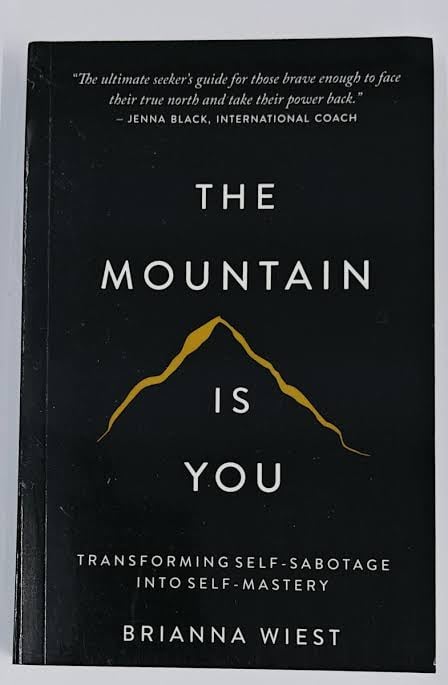
Introduction: The Mountain Is You
Some books change the way you think. Others change the way you live. "The Mountain Is You" by Brianna Wiest belongs to a rare category: books that change the way you see yourself.
Published in 2020, this book has resonated with millions of readers worldwide, becoming one of the most talked-about self-development titles of recent years. And it is easy to understand why. At its core, this book tackles one of the most uncomfortable truths about human nature: we are often our own greatest obstacle.
The title itself is a metaphor. The mountain you need to climb is not outside of you. It is you. It is the fears, the habits, the beliefs, and the behaviors that keep you stuck, sabotaging your own happiness and potential without even realizing it. This book is an invitation to stop running from yourself, and to finally start understanding who you are and why you do what you do.
About the Author: Brianna Wiest
Brianna Wiest is an American author, poet, and essayist known for her deeply introspective writing on self-awareness, emotional healing, and personal transformation. She has written for some of the most widely-read digital publications and built a massive following through her ability to put complex psychological ideas into simple, accessible, and beautifully written language.
Before "The Mountain Is You," she authored several successful books, including "101 Essays That Will Change the Way You Think" — a collection that similarly became a viral sensation among readers seeking honest, thought-provoking perspectives on life.
What makes Brianna Wiest stand out in the crowded self-help space is her refusal to offer easy answers or toxic positivity. She does not tell you that everything will be fine. Instead, she asks you to look closely at why things are not fine, and to take full responsibility for the unconscious patterns driving your choices. Her writing feels like a candid conversation with a very wise friend who sees through all your excuses — and still believes in your ability to grow.
What Is Self-Sabotage? The Core Concept of the Book
At the heart of "The Mountain Is You" lies a profound and often uncomfortable idea: self-sabotage is not a character flaw. It is not laziness, weakness, or stupidity. It is a deeply intelligent, if misguided, coping mechanism that develops in response to unmet needs, unresolved emotions, and unconscious beliefs formed early in life.
Wiest argues that when we self-sabotage, we are actually trying to protect ourselves. We sabotage relationships because we are afraid of being abandoned or hurt. We sabotage our careers because we fear failure, or surprisingly, we fear success. We procrastinate because somewhere deep inside, we believe we are not worthy of achieving our goals.
The book identifies several key forms of self-sabotage:
- Choosing comfort over growth, even when growth is exactly what we need
- Creating problems to solve instead of addressing the real underlying issue
- Avoiding vulnerability to protect ourselves from emotional pain
- Seeking external validation instead of developing inner security
- Living in a comfort zone so small it slowly suffocates our potential
Understanding self-sabotage, according to Wiest, is the first and most crucial step toward genuine transformation. You cannot overcome what you refuse to see.
Key Themes: What the Book Covers
"The Mountain Is You" is organized around several powerful themes that together paint a complete picture of how and why we hold ourselves back, and what we can do to move forward.
-
Emotional intelligence and self-awareness Wiest dedicates a significant portion of the book to helping readers understand their emotions rather than suppress or escape them. She explains that our feelings are messengers, not enemies. Learning to sit with discomfort, identify what it is trying to tell you, and respond with intention rather than reaction is a skill that fundamentally changes your relationship with yourself.
-
Rewriting your inner narrative Many of our self-limiting beliefs are stories we have been telling ourselves for years, often since childhood. The book challenges readers to examine those stories critically: Are they actually true? Who told you that you were not smart enough, not lovable enough, not capable enough? And more importantly, what would your life look like if you stopped believing them?
-
The difference between trauma response and conscious choice One of the most eye-opening aspects of this book is the way Wiest explains how unhealed trauma shapes our adult behavior. Without realizing it, we recreate familiar dynamics from the past because they feel safe, even when they are deeply unhealthy. Recognizing this pattern is the beginning of true freedom.
-
Building a life that actually fits you The final sections of the book shift from diagnosis to direction. Wiest offers practical guidance on how to start making decisions aligned with your authentic self rather than your fears, how to set meaningful goals, and how to build daily habits that support the life you genuinely want to live.
Writing Style and Tone
One of the most frequently praised aspects of "The Mountain Is You" is its writing style. Brianna Wiest writes with a rare combination of clinical clarity and emotional warmth. She does not lecture or preach. She sits beside you and speaks honestly, as if she knows exactly what you have been going through.
The prose is lyrical but never self-indulgent. Sentences are sharp, precise, and loaded with meaning. Many readers report that they had to stop and re-read certain paragraphs multiple times, not because they were confusing, but because they were hitting too close to home.
The book avoids the two most common pitfalls of the self-help genre. First, it never sugarcoats reality with empty affirmations or superficial positivity. Second, it never becomes so heavy or academic that it feels inaccessible. Wiest strikes a remarkable balance: she is both intellectually rigorous and deeply human.
Chapters are relatively short and digestible, making the book ideal for reading in focused sessions. Each section feels complete in itself, yet the chapters build upon each other to create an increasingly powerful overall argument. By the final pages, the reader has traveled through genuine introspection, and something has likely shifted.
Who Should Read This Book?
"The Mountain Is You" is one of those books that feels like it was written specifically for you, no matter who you are. However, there are certain readers who will get the most out of it:
-
Anyone who feels stuck in life and cannot quite figure out why. You have the ambition, you have the ideas, but somehow you keep getting in your own way. This book was written for you.
-
People going through major life transitions — a breakup, a career change, the end of a friendship, or simply the feeling that the life you are living no longer fits who you are becoming.
-
Those who have been through therapy or are currently in therapy and want a companion book that reinforces and deepens that inner work.
-
Young adults in their twenties and thirties who are figuring out their identity, their values, and the direction they want their lives to take.
-
Anyone who is tired of surface-level self-help advice and wants something that actually goes deep, confronts real psychological patterns, and offers genuine insight rather than motivational clichés.
-
Readers who enjoy books that blend psychology, philosophy, and personal development in an eloquent, readable format.
If you have ever caught yourself wondering why you keep repeating the same patterns, choosing the same kinds of relationships, or backing away from the very things you claim to want most — this book holds answers you did not know you were looking for.
Final Verdict: Start Climbing Your Mountain
"The Mountain Is You" is not just a book. It is a mirror. A clear, honest, sometimes confronting mirror that reflects back the parts of yourself you have been avoiding, minimizing, or outright ignoring.
Brianna Wiest has crafted something genuinely rare in the world of self-help: a book that is both intellectually honest and emotionally healing, that challenges you without shaming you, and that inspires genuine change rather than fleeting motivation.
This is not a book that promises overnight transformation. It is a book that asks you to do the harder, deeper work of truly understanding yourself. And it argues, convincingly, that this inner work is the only work that actually matters.
The mountain is real. It has always been there. The only question is whether you are ready to stop pretending it does not exist, and start finding your way through.
If you are ready to stop self-sabotaging and start building a life that is genuinely aligned with who you are, "The Mountain Is You" is the book to begin with. Get your copy now from Riwaya and take the first step toward becoming the person you have always known you could be.